



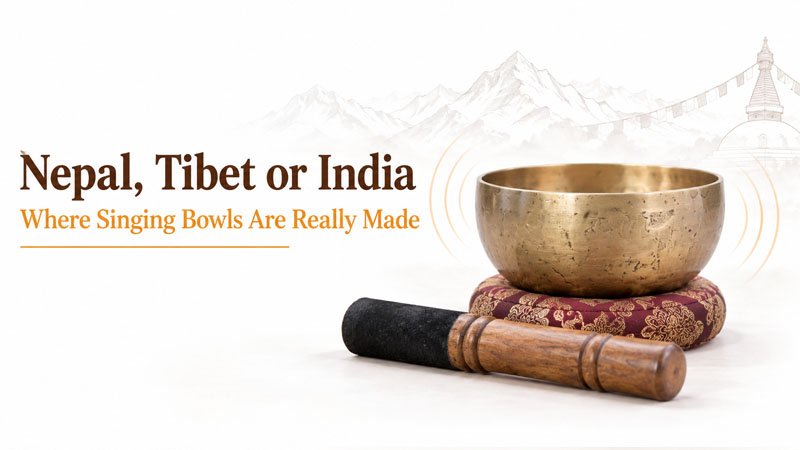
Nepal, Tibet or India - Where Singing Bowls Are Really Made
Most bowls sold as Tibetan singing bowls today are made in Nepal and northern India, not in Tibet. Tibetan is the name the world knows them by, and our bowls are made in Nepal.
Key takeaways
- Nepal and northern India make most of the bowls sold today.
- Tibetan, Himalayan and Nepali are names for the same instrument.
- The country alone does not decide quality. The making and the sound do.
- Ask the seller where and how the bowl was made.
Where do singing bowls come from today?
- Nepal: the home of most hand-hammered bowls sold today, including ours.
- Northern India: also makes and sells singing bowls.
- Tibet: gives the instrument its best known name.
The reference article on the standing bell says the same: bowls sold as Tibetan come from northern India or Nepal.
Why are they called Tibetan singing bowls?
Because that is the name that spread around the world. Buyers search for it, so shops, including ours, still use it.
The early history of the bowls is widely reported but not well recorded. We tell it as tradition in the origin of the singing bowl, and we never put a date on a bowl.
What do the different names mean?
| Name you see | What it usually means |
|---|---|
| Tibetan singing bowl | The common world name. It does not tell you where the bowl was made. |
| Himalayan singing bowl | The same instrument, named for the region. |
| Nepal, Nepali or Nepalese singing bowl | A bowl made in Nepal. |
| Hand-hammered | Hot bronze beaten into shape by hand. |
| Hand-cast, often called machine made | Metal poured into a mould. No machine makes singing bowls. |
Our lesson on what a Himalayan singing bowl is explains the instrument from the start.
Looking for a singing bowl from Nepal?
See all our singing bowls, made in Nepal. A mallet and cushion come with every bowl.
Does the country decide the quality?
No. A good and a poor bowl can come from the same town. What matters is how the bowl was made and how it sounds.
- Hand-hammered bowls: uneven hammer marks, several tones and a long ring. See our hand-hammered singing bowls.
- Hand-cast bowls: a smooth, even wall and a clear, simple tone. See our hand-cast singing bowls.
Use the five point check in how to tell an authentic singing bowl to see which kind you have.
How are our bowls made and sent?
- Hammered in Nepal: the bowl is hammered by hand, and its note is discovered, not made.
- Chosen for your order: after your order arrives, Sunita chooses one bowl from her experience in practice.
- Sent from Kathmandu: dispatched in 3 to 4 business days by DHL Express.
The steps of the making are shown in how Tibetan singing bowls are made.
What should you ask a seller?
- Where was it made? A clear answer names a country, and often a town.
- How was it made? Hand-hammered or hand-cast.
- Where is it sent from? A bowl sent from Nepal comes straight from the source.
- Who chose it? Someone who plays bowls, or nobody at all.
Our guide to buying singing bowls online from Nepal covers the rest.
What are the common mistakes?
- Paying for the word Tibetan: the name does not prove where a bowl was made.
- Judging by country: "made in Nepal" does not by itself mean hand-hammered.
- Believing a date: nobody can honestly date an old bowl.
- Not asking: an honest seller answers these questions easily.
What should you do next?
- See the kinds of bowl: read types of Tibetan singing bowls.
- Old collected bowls: see antique and collected singing bowls.
- A bowl made your way: design one on the custom singing bowl page.
- Learn to play: take the free singing bowl healing course.
Frequently asked questions
Where are singing bowls made today?
Most bowls sold as Tibetan singing bowls today are made in Nepal and northern India. Ours are made in Nepal.
Are Tibetan singing bowls made in Tibet?
Usually not. Tibetan is the name the world knows the instrument by, and most bowls sold under that name are made in Nepal and northern India.
What is the difference between a Tibetan and a Nepali singing bowl?
In most shops there is no difference in the instrument. Tibetan, Himalayan, Nepali and Nepalese are different names for the same kind of metal bowl.
What is a Himalayan singing bowl?
It is another name for the same instrument. Many makers and teachers prefer it because it names the region and not one country.
Is a singing bowl from Nepal better?
The country alone does not decide quality. How the bowl is made and how it sounds matter more, so check whether it is hand-hammered or hand-cast.
How old are singing bowls?
Their early history is widely reported but not well recorded. We do not put a date on any bowl, including the old collected ones we sell.
Where does Dharma Tool send bowls from?
From Kathmandu, Nepal. Orders are dispatched in 3 to 4 business days by DHL Express.
Ready to choose a bowl from Nepal?
Browse every bowl we offer. Sunita chooses your bowl after the order arrives.