




Which Singing Bowl Is Easiest to Play?
The easiest singing bowl to play is a hand-casted bronze bowl of medium size, roughly 15 to 20cm across. Casting produces near-uniform wall thickness, which lets the friction cycle establish quickly and hold steady — so the tone builds within a few revolutions and does not collapse when your pressure wavers. Small thick bowls are the hardest to rim; large heavy ones demand patience. A medium cast bowl forgives almost everything a beginner does wrong.
Most people who give up on singing bowls give up in the first week. They buy a beautiful hand-forged bowl, bring the mallet to the rim, get a scratchy rattle, try again, get the same rattle, and quietly conclude they have no talent for it.
They are usually wrong about the talent, and right that something is off. Bowls vary enormously in how readily they sing, and the difference comes down to how they were made. A hand-casted singing bowl will sing for a complete beginner on the first evening. Many hand-forged bowls will not.
There is a habit in this trade of treating hand-forged as the real thing and everything else as a compromise. It is a comfortable position, and it happens to be the one with the higher margin attached. The truth is more useful: casting and forging are two ways of making an instrument, and each has genuine strengths. This guide covers what makes a bowl easy or difficult to play, who cast bowls suit, and — honestly — who should buy hand-forged instead.
What Is a Hand-Casted Singing Bowl?
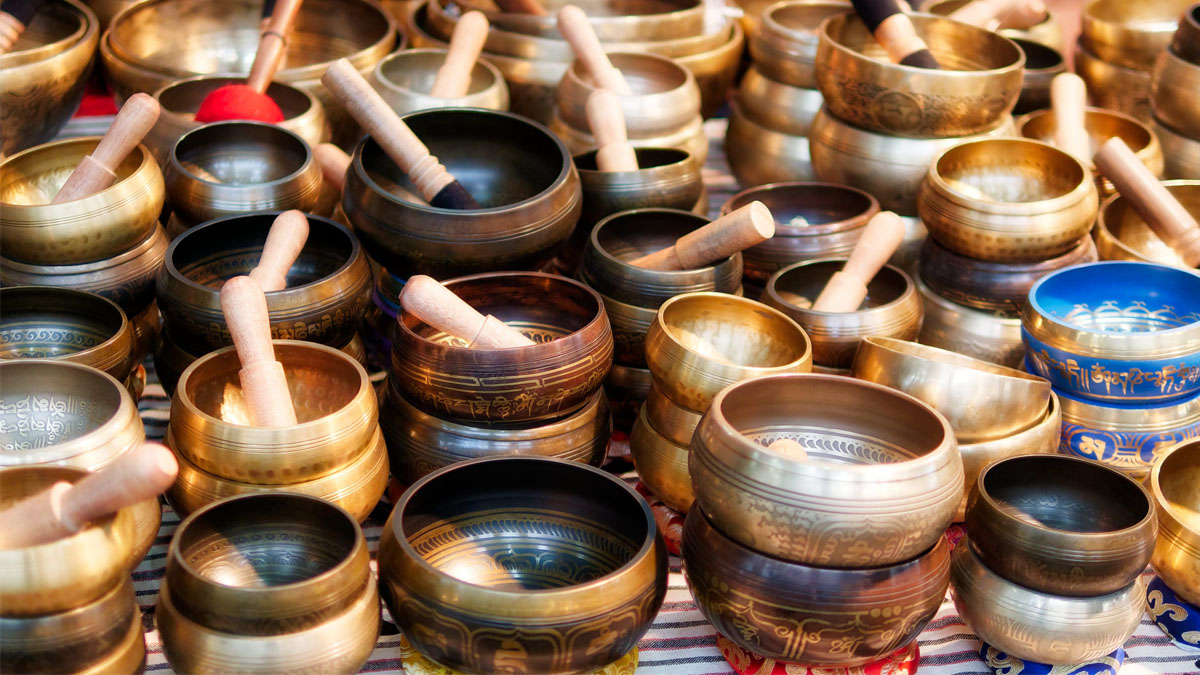
Molten bronze is poured into a mould, allowed to cool, then released, filed, turned, finished and tuned by hand. The forming is done by the mould; everything after it is done by a person.
Hand-forging works the other way. A disc of bronze is heated and hammered — thousands of strikes over hours, gradually raising the flat metal into a bowl. The form emerges from repeated impact rather than from a mould.
The consequence that matters is wall thickness. A cast bowl has walls of near-uniform thickness because the mould determines them. A forged bowl has walls that vary minutely across the whole surface, because a human arm cannot strike identically ten thousand times.
Almost every real difference between the two follows from that single fact. Uniform walls vibrate as one coherent surface and produce a clean, stable, predictable tone. Varied walls produce many stable frequencies at once — the layered overtone shimmer that hand-forged bowls are prized for.
Both are hand-finished. Both are bronze. Neither is machine-pressed brass, which is a genuinely different and lesser thing altogether.
What Makes a Singing Bowl Easy or Hard to Play?
Three things decide how readily a bowl sings, and only one of them is about your technique.
Wall uniformity. Rimming works through stick-slip friction — the mallet grips and releases hundreds of times a second, each catch feeding energy into the metal. Uniform walls let that cycle establish quickly and stay stable. Walls that vary in thickness make the contact behave differently at different points around the rim, so the tone builds unevenly and drops out more easily. This is the single biggest factor, and it is exactly what casting controls.
Wall thickness. Thicker walls hold more mass and more internal damping, so they need more revolutions before the tone establishes. A thick bowl is not faulty when it takes ten circuits to sing — that is simply what it is.
Size. Rim circumference decides how much energy each revolution delivers. Small bowls have short rims, so each pass gives less. A small bowl with thick walls is the hardest combination there is, and some cannot be rimmed at all by design.
Put together, this gives the answer: a medium bowl with uniform walls is the most forgiving instrument you can hold. Our guide on why a singing bowl takes time to sing covers the technique side in full, including the errors that defeat most beginners regardless of which bowl they own.
Who Should Buy a Hand-Casted Singing Bowl?
Beginners Who Want a Bowl That Actually Sings
This is the strongest case, and it is underrated because it sounds unglamorous.
Uniform wall thickness makes a bowl considerably easier to rim. The stick-slip friction cycle establishes quickly and stays stable, so the tone builds in a few revolutions instead of ten and does not collapse when your pressure wavers. Beginners get a clear singing tone almost immediately.
That matters more than it appears to. A great many people buy a beautiful hand-forged bowl, cannot make it sing, conclude they are doing it wrong, and quietly stop. Our guide on why a singing bowl takes time to sing exists precisely because this is so common. A forgiving bowl that rewards a beginner on the first evening is worth more than an impressive one that defeats them.
Anyone Who Needs a Specific Note
Casting produces predictable pitch. Dimensions and wall thickness are set by the mould, so the fundamental can be targeted before the metal is poured.
Hand-forging cannot promise this. The note emerges from the process — alloy, curvature, thickness, hammering pattern, heat cycles — and is identified after the bowl is finished rather than decided beforehand. That unpredictability is part of the romance of a forged bowl, and it is a real obstacle if you need a C.
If your practice is built around specific frequencies, or you work to the chakra note system, casting is how you reliably get what you need.
People Building a Matched Set
The same logic, multiplied by seven. Assembling a set of hand-forged bowls in correct chakra notes means searching for whichever pieces happen to exist in the right pitches, and hoping their characters suit each other.
Cast bowls can be produced to the notes. A chakra singing bowl set built this way is consistent in tone quality across all seven, which matters when you are moving between them in a single session and do not want one bowl to sound like a stranger.
Therapists Doing Body-Placement Work
Cast bowls are typically thicker and heavier. Thicker walls lower the fundamental, and a lower fundamental means more of the tone lands inside the range the body registers as physical vibration rather than only as sound — the mechanism covered in our article on sound and vibration.
For work where the bowl sits on or near a client's body, that felt component is the entire point. The added robustness helps too: an instrument handled every working day, carried between rooms and set down by tired hands, benefits from being solid.
Anyone Who Wants One Clear Tone
Cast bowls give a purer, more singular fundamental with less overtone complexity. In some contexts that is precisely the feature.
A bowl used as a focus cue needs a clean tone that is easy to follow to silence — competing overtones make that harder, not more interesting. A bowl for recording or streaming cuts through a mix where a complex bowl turns muddy. A bowl for opening and closing a class needs to be unmistakable rather than beautiful.
Teachers and Studios Who Need Reliability
A bowl that must work in front of twenty people, every week, played by whichever teacher is on that day, needs to be dependable more than it needs to be characterful. Cast bowls are consistent, forgiving, and hard to embarrass yourself with.
Clean tone, reliable note, forgiving to play
Every bowl in our hand-casted collection is bronze, hand-finished and hand-tuned by artisans in the Kathmandu Valley. Compare them against hand-forged bowls, or explore chakra sets where consistent tone across seven bowls genuinely matters.
Why a Well-Chosen Cast Bowl Can Sound Better Than a Handmade One
Here is the part the trade prefers not to say out loud.
Hand-forging carries enormous variance. When it goes well the result is extraordinary — layered overtones, long sustain, a bowl with genuine personality. When it goes less well you get uneven wall thickness producing overtones that beat against each other, a fundamental that wobbles rather than holds, or a tone that dies in four seconds.
Both outcomes get sold. Both are legitimately hand-forged. The label describes the process, not the result.
Casting has far tighter tolerances. The ceiling is lower — no cast bowl will produce the shimmer of an exceptional forged one — but so is the floor, by a considerable margin. A good cast bowl is reliably good.
Which leads somewhere uncomfortable for most sellers: a well-chosen cast bowl will outperform a mediocre hand-forged bowl on clarity, stability and sustain. Not occasionally. Routinely. The individual instrument decides, not the method.
This is the same principle that applies to age. Antique bowls are not automatically better than new ones — craftsmanship matters far more than years, as our comparison of new handmade and antique bowls sets out. Process and age are both proxies. Neither is the thing itself.
Which Is Why Selection Matters More Than Method
If the method does not guarantee the result, the only thing that does is someone playing the bowl and listening to it.
That is how the Dharma Tool collection is assembled. Sunita plays every bowl before it is listed — cast or forged — and judges it on resonance, sustain, harmonic behaviour and character. A hand-forged bowl that sounds thin does not make the collection. A cast bowl that sings beautifully does.
Buying by category alone means trusting a label. Buying from a collection selected by ear means someone has already done the listening.
Who Should Not Buy a Hand-Casted Bowl?
Three groups, and the reasons are honest.
Anyone chasing overtone complexity. The layered, three-dimensional shimmer of a fine hand-forged bowl comes directly from irregularity. Casting removes irregularity by design. If that quality is what you want, no cast bowl will deliver it — and you should buy hand-forged instead.
Anyone who wants visible craft. Cast bowls are smooth and even. No hammer marks, no asymmetry, no evidence of the hours. Some people find that clean and modern; others find it lifeless. It is a matter of what you want to look at every day.
Collectors. The collector market values hand-forging, provenance and age. Cast bowls do not appreciate the way antique hammered bowls have. If part of the purchase is an investment or a collection, this is the wrong category.
Hand-Cast and Hand-Forged: What Each Gives You
| Hand-casted | Hand-forged | |
|---|---|---|
| Wall thickness | Near uniform | Varies minutely across the surface |
| Fundamental tone | Clean, stable, singular | Complex, sometimes muddier |
| Overtones | Fewer, well blended | Many, layered — occasionally competing |
| Note accuracy | Can be specified in advance | Emerges from the process |
| Ease of playing | Forgiving, sings readily | Varies by bowl, can be demanding |
| Consistency across a set | High | Each bowl its own character |
| Best possible bowl | Very good | Exceptional |
| Worst likely bowl | Still decent | Genuinely poor |
| Collector value | Limited | Strong, especially with age |
The two rows worth sitting with are the last three. Forging has the higher ceiling and the lower floor. Casting has the narrower band. Which suits you depends entirely on whether you are buying one bowl you need to work, or hunting for something remarkable.
How to Choose a Good Hand-Casted Bowl
- Listen for sustain. A good cast bowl rings for a long time and fades smoothly. Short or abrupt decay is the clearest sign of a poor one.
- Check the tone holds steady. The pitch should stay where it is rather than wavering or beating. Uniform walls should produce a stable fundamental — if it wobbles, the casting or finishing was poor.
- Confirm the note if it matters. Casting makes pitch specifiable, so ask. If you are buying for a specific frequency, that is the whole reason to choose cast.
- Feel the wall. Thicker walls mean a lower fundamental and more felt vibration. For body work, weight is an advantage rather than a drawback.
- Play it before deciding, or buy where someone else has. Method does not guarantee quality. Only listening does.
If you cannot play a bowl before buying, the practical substitute is buying from a collection where each piece has already been played and judged. The healer-selected process exists for exactly that reason.
When to Commission Instead
For a specific note at a specific size — a matched set to your own specification, a heavy bowl for treatment work, an engraved piece — the custom singing bowl service lets you set size, wall thickness, note, metal composition and engraving rather than searching for a bowl that happens to match.
The Short Answer
Buy hand-casted if you want a bowl that sings easily, holds a specific note, sounds consistent alongside others, and works reliably every time you pick it up.
Buy hand-forged if you want an instrument with character, complexity and the marks of the person who made it — and you are willing to choose carefully, because the range of quality is wide.
What decides the outcome is not which process made the bowl. It is whether that particular bowl is any good.
Every bowl played and judged before it reaches the collection
Cast or forged, the individual instrument decides. Sunita plays every bowl for resonance, sustain and character before it is listed. Browse hand-casted bowls, hand-forged bowls, or commission a bowl to the exact note and weight your practice needs.
Frequently Asked Questions
Which singing bowl is easiest to play?
A hand-casted bronze bowl of medium size, roughly 15 to 20cm across. Casting gives near-uniform wall thickness, which lets the friction cycle establish quickly and hold steady, so the tone builds within a few revolutions rather than ten. Small bowls with thick walls are the hardest to rim — short rim circumference delivers less energy per revolution while thick walls demand more.
Who are hand-casted singing bowls best for?
Beginners who want a bowl that sings easily, practitioners who need a specific musical note, anyone building a matched set of bowls, therapists doing body-placement work, and teachers who need instruments that perform reliably in front of a group. The uniform wall thickness that comes from casting produces a clean stable tone, a predictable pitch and a forgiving response.
Are hand-casted bowls lower quality than handmade ones?
No. They are made differently and suit different purposes. Casting produces tighter consistency and a cleaner fundamental; hand-forging produces more complex overtones and more individual character. A well-made cast bowl will outperform a poorly-made forged bowl on clarity, stability and sustain. The individual instrument matters more than the method used to make it.
Can a hand-casted bowl sound better than a handmade one?
Yes, frequently. Hand-forging has wide quality variance — when it goes well the result is exceptional, and when it goes less well the bowl can have competing overtones, an unstable fundamental or a short sustain. Casting has much tighter tolerances, so a good cast bowl is reliably good. A well-chosen cast bowl routinely beats a mediocre forged one.
Are hand-casted singing bowls easier to play?
Generally yes. Uniform wall thickness allows the friction cycle to establish quickly and stay stable, so the tone builds in fewer revolutions and is less likely to collapse if your pressure varies. Beginners usually get a clear singing tone almost immediately, which matters because many people give up on an irregular bowl believing the fault is theirs.
Which is better for a chakra set, cast or forged?
Cast, in most cases. Pitch can be specified in advance, so a set can be produced to the correct notes rather than assembled from whichever forged bowls happen to exist in the right pitches. The tone quality is also consistent across all seven, which matters when moving between them in one session.
Do hand-casted bowls hold their value?
Less than hand-forged bowls. The collector market values hammering, provenance and age, and antique forged bowls have appreciated as supply declined. Cast bowls are bought as working instruments rather than collectables. If resale value or investment is part of the purchase, hand-forged or antique is the right category.