



Samantabhadra Yab-Yum Singing Bowl - What the Image Means
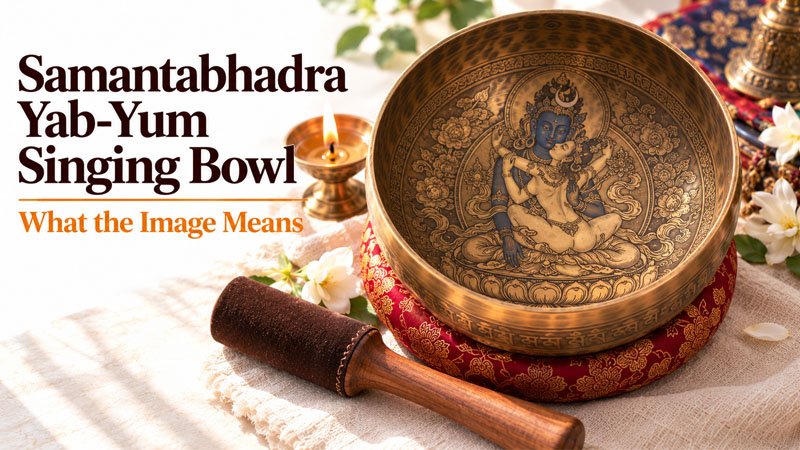
A Samantabhadra Yab-Yum singing bowl shows Samantabhadra, the primordial Buddha of the Nyingma tradition, in union with his consort Samantabhadri. Yab-yum means father-mother, and the image is a symbol: compassion and wisdom joined as one, the awakened mind. Blue for limitless space, white for wisdom, both bare, show the mind as it is.
Key takeaways
- Who: Samantabhadra, Kuntuzangpo, "the All-Good", with Samantabhadri.
- Yab-yum: father-mother, the union of compassion and wisdom.
- The colours: blue for space, white for wisdom; no clothes for the mind as it is.
- On our bowls: the pair inside, mantra around, an endless knot or lotus mandala below.
Who is Samantabhadra?
In the Nyingma tradition of Tibetan Buddhism, Samantabhadra is the primordial Buddha: not a person from history but the pure, timeless awareness that is the nature of every mind. The Buddhas of the five families, explained in the Five Buddhas on singing bowls, are said to arise from him.
His Tibetan name is Kuntuzangpo, "all good" or "ever good". The Aspiration Prayer of Samantabhadra is widely chanted in Himalayan communities, and it teaches the practitioner to rest in the natural state of mind.
Is he the same as the bodhisattva Samantabhadra?
| Primordial Buddha Samantabhadra | Bodhisattva Samantabhadra | |
|---|---|---|
| Tradition | Nyingma, Tibetan Buddhism | Mahayana, across Asia |
| Looks like | Sky blue, bare, in meditation, often with his consort | Crowned, riding a white elephant with six tusks |
| Stands for | The nature of mind itself | Practice and great vows |
| On our bowls | Yes, in yab-yum | No |
They share a name, "All Good", but they are two different beings. The figure on our bowls is always the primordial Buddha.
What does yab-yum mean?
Yab-yum is Tibetan for "father-mother". In the symbolic language of tantra, the male figure stands for compassion and skilful means and the female for wisdom; their union shows the two working as one, beyond any split between self and other.
It is sacred art, read as a symbol of awakening rather than of ordinary romance. You will see yab-yum images in Himalayan monasteries and shrines, and on thangkas, statues and bowls.
What does each part of the image show?
| Look for | What it shows |
|---|---|
| Sky-blue Samantabhadra | Space without limit, the open nature of mind |
| White Samantabhadri | Wisdom, the clear side of the same mind |
| No clothes or jewels | The mind as it is, with nothing added |
| Hands in meditation | His hands rest in his lap, behind her |
| Lotus and moon seat | Purity, untouched by the world |
On an etched bowl you see the pair as one shape: a seated Buddha with a smaller figure in his lap, her back to you. That is how to recognise the yab-yum at a glance.
Where do the image and mantra appear on a bowl?
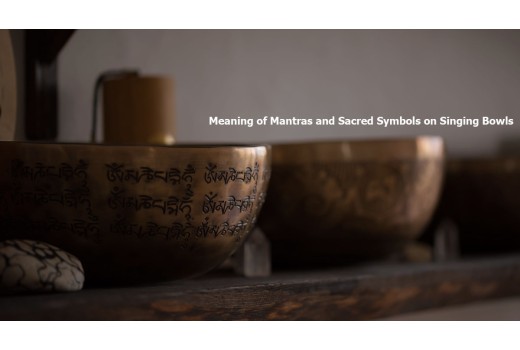
On our Samantabhadra bowls, the pair is etched at the centre inside. Around the outside runs Om Mani Padme Hum or a band of Tibetan mantra, and the base carries an endless knot or a lotus mandala with mantra.
Samantabhadra has no short everyday mantra of his own, so the ring is usually Om Mani Padme Hum, explained in Om Mani Padme Hum singing bowl.
Looking for a Samantabhadra bowl?
Our premium Samantabhadra Yab-Yum bowl has the pair at the centre, carved Tibetan mantra around them and a lotus mandala with mantra on the base, in 10 to 12 inches.
Which Samantabhadra bowl should you choose?
| If you want | Look at |
|---|---|
| A lotus mandala on the base | Premium Samantabhadra Yab-Yum bowl, 10 to 12 inches |
| Om Mani Padme Hum around the pair | Samantabhadra Yab-Yum singing bowl, 8 to 12 inches |
| Etched by thangka artists, the widest size range | Samantabhadra Yab-Yum Tibetan bowl, 7 to 12 inches |
Every figure bowl is in carved and etched singing bowls.
How do you use a Samantabhadra bowl?
- Strike once and listen as the sound spreads and thins.
- Follow it into silence: as it fades, rest in the quiet that is left.
- Hold nothing, push nothing away: let thoughts come and go, the way the sound does.
- Strike again only when you notice you have drifted.
This simple practice echoes Samantabhadra's prayer: resting in the natural state of mind. It supports relaxation and focus, and does not treat any condition.
How should you keep a Yab-Yum bowl?
Keep it as you would any sacred image: clean, on a cushion, shelf or altar rather than the floor, and handle it with care. Every figure you may meet on a bowl is explained in deities on singing bowls, and other symbols in singing bowl symbols and mantras.
We can also engrave Samantabhadra Yab-Yum at the centre of a custom singing bowl, with the mantra of your choice around the pair.
Frequently asked questions
What does yab-yum mean?
Yab-yum is Tibetan for father-mother. The image shows a Buddha in union with his consort, a symbol of compassion and wisdom joined as one.
Is the yab-yum image sexual?
It is sacred art and is read as a symbol. In the language of tantra, the male figure stands for compassion and skilful means and the female for wisdom; their union is the awakened mind, where the two are never apart.
Who is Samantabhadra on a singing bowl?
Samantabhadra, Kuntuzangpo in Tibetan, is the primordial Buddha of the Nyingma tradition: the pure, timeless awareness that is the nature of mind.
Who is Samantabhadri?
His consort, shown white. She stands for wisdom and for the open, empty nature of mind.
Why is Samantabhadra blue and without clothes?
Sky blue stands for space without limit. The bare bodies, without clothes or jewels, show the nature of mind as it is, with nothing added.
Is he the same as the bodhisattva Samantabhadra on the white elephant?
No. They share a name, but the bodhisattva who rides a six-tusked white elephant is a different being from the primordial Buddha shown in yab-yum.
Can I have Samantabhadra engraved on my own bowl?
Yes. We can engrave Samantabhadra Yab-Yum at the centre of a custom singing bowl, with Om Mani Padme Hum or another mantra around the pair, and engraving is free.
Want Samantabhadra on your own bowl?
Choose the size and finish, and ask for Samantabhadra Yab-Yum with the mantra you want around the pair. Engraving is free, and Sunita chooses your bowl after your order arrives.