




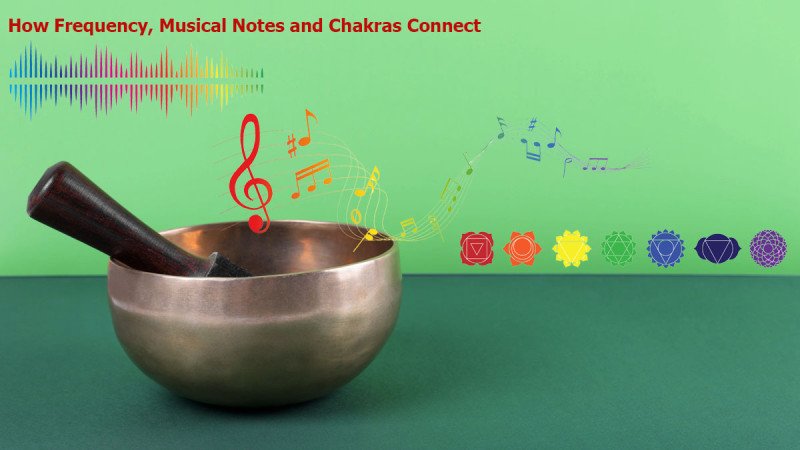
How Do Frequency, Musical Notes and Chakras Connect?
The chain has two links, and they are not the same kind of thing. Frequency determines the musical note — that is physics and arithmetic, precise and unarguable. The note then maps to a chakra by convention: seven notes matched to seven energy centres, a system assembled in the twentieth century. The first link is measurement. The second is a framework. Both are useful, and knowing which is which changes how you use them.
It is usually presented as one continuous chain. Frequency produces a note, the note corresponds to a chakra, therefore playing this bowl affects that part of you.
Two of those three steps are solid. The middle one is worth looking at properly, because understanding it tells you what a chakra bowl set actually gives you — and what it does not.
Link One: Frequency Determines the Note
This half is exact, and it is worth being precise about because the precision is genuinely useful.
A musical note is a frequency. Not associated with one, not corresponding to one — it is one. Under the standard A440 tuning, the A above middle C is defined as exactly 440 Hz, and every other note is calculated from there.
How the Numbers Work
An octave is a doubling. If C4 is 261.63 Hz, then C5 is 523.25 Hz and C3 is 130.81 Hz. Same note name, half or double the frequency. This is why a huge bowl and a tiny bowl can both be "C" while sounding nothing alike.
An octave divides into twelve semitones, each one a ratio of roughly 1.0595 — the twelfth root of two. That is why the numbers are not round.
Each semitone divides into 100 cents. This matters for bowls, because almost no hand-forged bowl sits exactly on a note. A bowl might measure 30 cents sharp of F, which is still called F because it is closer to F than to F sharp, but it is not F.
The practical consequence: a bowl described as a specific note is a bowl that measured nearest to that note under one set of playing conditions. Our article on the twelve factors that determine a singing bowl's frequency covers why that measurement shifts depending on how you play it.
The Tuning Standard Changes Everything
A440 is a convention, not a law of nature. Under A432 tuning, every note number shifts down by about 1.8 per cent — C becomes roughly 256 Hz rather than 261.63.
Which means a bowl that is "exactly C" in one system is slightly flat of C in the other. The bowl has not changed. The ruler has.
Link Two: The Note Maps to a Chakra
This half works differently, and being straight about it is more useful than pretending otherwise.
The standard mapping runs the seven notes of the major scale against the seven chakras in order — C at the root, ascending to B at the crown. It is neat, memorable, and it is a twentieth-century arrangement, largely Western in origin.
| Chakra | Note & frequency | Traditional seed sound |
|---|---|---|
| Root — Muladhara | C — 261.63 Hz | LAM |
| Sacral — Svadhisthana | D — 293.66 Hz | VAM |
| Solar Plexus — Manipura | E — 329.63 Hz | RAM |
| Heart — Anahata | F — 349.23 Hz | YAM |
| Throat — Vishuddha | G — 392.00 Hz | HAM |
| Third Eye — Ajna | A — 440.00 Hz | OM / KSHAM |
| Crown — Sahasrara | B — 493.88 Hz | Silence / OM |
Frequencies given at the fourth octave in A440 tuning. Our chakra note information page sets out the full range.
The Column Most People Have Never Seen
Look at the third column again, because it is the interesting one.
The traditional sound associated with each chakra is not a musical note. It is a syllable.
The classical chakra texts — the tantric sources these systems descend from — assign each centre a bija, a seed sound. LAM at the root, VAM at the sacral, RAM at the solar plexus, YAM at the heart, HAM at the throat. These are chanted, not played. They have no frequency attached, because frequency measurement did not exist when they were written and pitch was not the point.
Each centre also carries an element, a number of petals, a colour and a deity. It is a rich symbolic system. What it does not contain anywhere is a hertz value or a musical note.
So when someone says the chakras have always been linked to sound, they are right — and the sound is the bija mantra, not the note. The note mapping arrived much later, and it works by matching seven to seven rather than by descending from any tradition.
This is not a debunking. It is a correction of ancestry, and the older system is arguably the more interesting one.
Seven notes, root to crown, chosen to work together
A framework needs the range to be useful, and assembling seven matching notes one bowl at a time is difficult. Explore chakra singing bowl sets selected as a group, or check what note your existing bowl actually produces with our live frequency analyser.
The Octave Problem
Here is a question the standard chart does not answer, and it is worth sitting with.
A 10cm bowl at C5 is 523.25 Hz. A 35cm bowl at C2 is 65.41 Hz. That is a factor of eight between them — one is felt through the floor, the other is barely felt at all.
Both are called root chakra bowls.
Which tells you something important about how the mapping works. If any C counts regardless of octave, then the correspondence is not really to a frequency at all. It is to a note name — and note names are a human labelling system, not a physical property.
The frequency is doing the physics. The note name is doing the mapping. Those are two different jobs, and conflating them is where "this frequency resonates with that chakra" starts to lose its footing.
None of which stops a chakra set being useful. It just means the usefulness comes from having a structured range to work through rather than from any particular number landing on any particular part of the body.
So What Is a Chakra Set Actually Good For?
Three real things, none of them requiring the frequency claim.
Structure. Moving root to crown gives a session a shape both practitioner and client can follow without explanation. That is genuinely valuable, and structure is hard to improvise.
Range. Seven bowls chosen as a group span a far wider tonal range than any single instrument, and they are selected to sit together rather than clash. Assembling that one purchase at a time is difficult.
A shared vocabulary. If your client already thinks in chakras — and many people arriving at sound work do — the framework gives you common language for what is happening.
What a chakra set does not do is target a specific part of the body with a specific number. There is no evidence for that, and we are not going to claim it in order to sell seven bowls. Our article on what science supports about singing bowls covers where the evidence sits more broadly.
What This Means When You Are Buying
Four practical conclusions from the chain.
A stated note is approximate. Hand-forged bowls rarely land exactly on a note, and the measurement shifts with strike position, mallet and force. A bowl sold as F is nearest to F under one set of conditions. If you need precision, hand-casted bowls have predictable pitch, and a commissioned bowl can be made to the note.
Check which tuning standard is meant. A440 and A432 give different numbers for the same note names. Neither is more correct, but they are not interchangeable, and a set assembled across both will not sit together.
Octave matters more than note name for how a bowl feels. If you want something you can feel in the body, you are choosing an octave — which means choosing a size. The note name is a secondary consideration.
Buy the set for the range, not the numbers. Seven bowls that sound good together and give you a structure to work in is worth having. Seven bowls bought because specific frequencies do specific things is a purchase built on something that will not hold up.
If the number matters to your practice, set it at the forge
Hand-forged pitch emerges rather than being targeted, so a specific note means specifying it in advance. Through Dharma Tool's custom singing bowl service you choose size, note, wall thickness and engraving — including matched pieces to complete a set — hand-forged by artisans in Kathmandu.
Holding Both Halves
The honest summary is that this is one chain made of two different materials.
Frequency to note is arithmetic. It is exact, checkable, and it genuinely tells you something about the instrument in front of you — what octave it occupies, how it will behave, whether you will feel it or only hear it.
Note to chakra is a framework. It was assembled rather than inherited, it works by matching seven to seven, and it is useful for the reasons frameworks are useful: it organises practice, gives it shape, and provides shared language.
Neither of those is diminished by being what it is. The arithmetic does not need to be mystical to matter, and the framework does not need to be ancient to work. What causes trouble is treating the second half as though it had the precision of the first — because that is the claim that falls apart when someone checks, and takes the credible parts down with it.
Frequently Asked Questions
How do frequency, musical notes and chakras connect?
Frequency determines the musical note by exact arithmetic — a note is a frequency, with A defined as 440 Hz and everything else calculated from there. The note then maps to a chakra by convention: seven notes of the major scale matched to seven energy centres, a system assembled in the twentieth century. The first link is measurement, the second is a framework.
What frequency is each chakra?
In the standard A440 mapping at the fourth octave: root C at 261.63 Hz, sacral D at 293.66, solar plexus E at 329.63, heart F at 349.23, throat G at 392.00, third eye A at 440.00, and crown B at 493.88. These shift by octave — any C counts as root whether it is 65 Hz or 523 Hz — and all the numbers change under A432 tuning.
Is the chakra-note mapping traditional?
No. The classical chakra texts assign each centre a bija or seed sound — LAM, VAM, RAM, YAM, HAM — which are chanted rather than played and carry no frequency. Each centre also has an element, petal count, colour and deity. What the traditional system does not contain anywhere is a hertz value or a musical note. The note mapping is a twentieth-century arrangement, largely Western.
Does the octave matter for chakra bowls?
It matters enormously for how the bowl feels, and not at all for the mapping — which is revealing. A 10cm bowl at C5 and a 35cm bowl at C2 are both called root chakra bowls despite being a factor of eight apart, one felt through the floor and the other barely felt at all. The correspondence is to a note name rather than to a frequency.
Are chakra singing bowl sets worth buying?
For structure, range and shared vocabulary, yes. Moving root to crown gives a session a shape both practitioner and client can follow, seven bowls chosen as a group span a far wider range than one instrument, and the framework gives you common language with clients who already think in chakras. What a set does not do is target a specific part of the body with a specific number.
Does A432 tuning change the chakra frequencies?
Yes. Under A432 every note number shifts down by about 1.8 per cent, so C becomes roughly 256 Hz rather than 261.63. A bowl that is exactly C in one system is slightly flat of C in the other — the bowl has not changed, the reference has. Neither standard is more correct, but they are not interchangeable, and a set assembled across both will not sit together.