



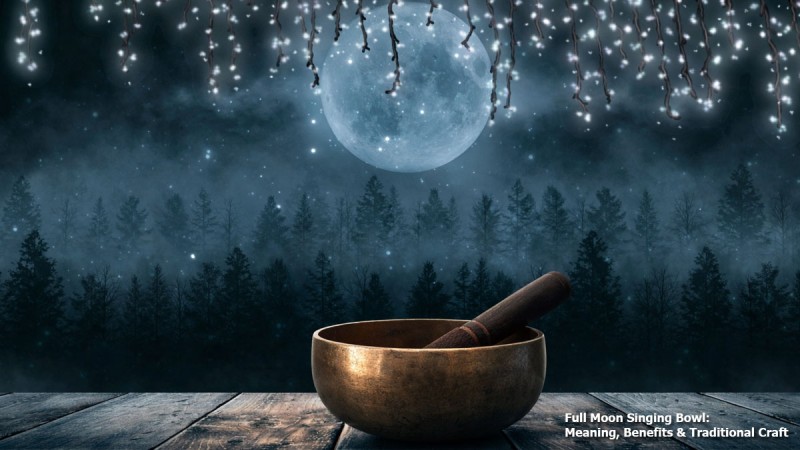
Full Moon Singing Bowl Meaning: What It Is, Benefits and How It Is Made
Short answer: what does a full moon singing bowl mean?
A full moon singing bowl is a Himalayan singing bowl hand-hammered on the night of the full moon, called Purnima in Nepal. In Hindu and Buddhist tradition the full moon stands for completion, clarity and a calm, bright mind, so a bowl made on that night is understood to carry that meaning. The metal and the method are the same as any hand-hammered bowl. What sets it apart is when it was made and the intention behind it.
Among Himalayan singing bowls, the full moon singing bowl has a place of its own. People choose it for the tradition behind its making as much as for its sound. This guide explains what the full moon means in Nepal, how these bowls are made, what they are used for, and what is belief and what is fact.
What is a full moon singing bowl?
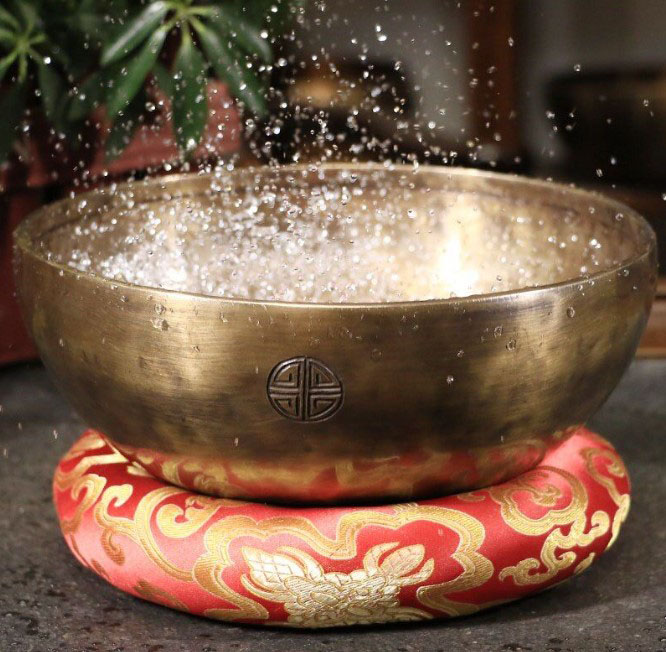
A full moon singing bowl, sometimes called a moon bowl, is a metal singing bowl whose hammering is timed to the night of a full moon. The smiths plan their work by the lunar calendar and do the forging at night, when the moon is full.
It looks like any other hand-hammered bowl. Nothing in the alloy is different, and nothing in the shape. The difference is the timing and the meaning attached to it.
| Full moon singing bowl | Regular hand-hammered bowl | |
|---|---|---|
| When it is made | On the night of the full moon | On any working day |
| Metal | Traditional seven-metal alloy | Traditional seven-metal alloy |
| Method | Hand-hammered from a heated disc | Hand-hammered from a heated disc |
| Sound | Layered overtones, long sustain | Layered overtones, long sustain |
| Meaning | Carries the symbolism of the full moon | No lunar association |
| How often | Once a month, in small batches | All month |
The spiritual meaning of the full moon
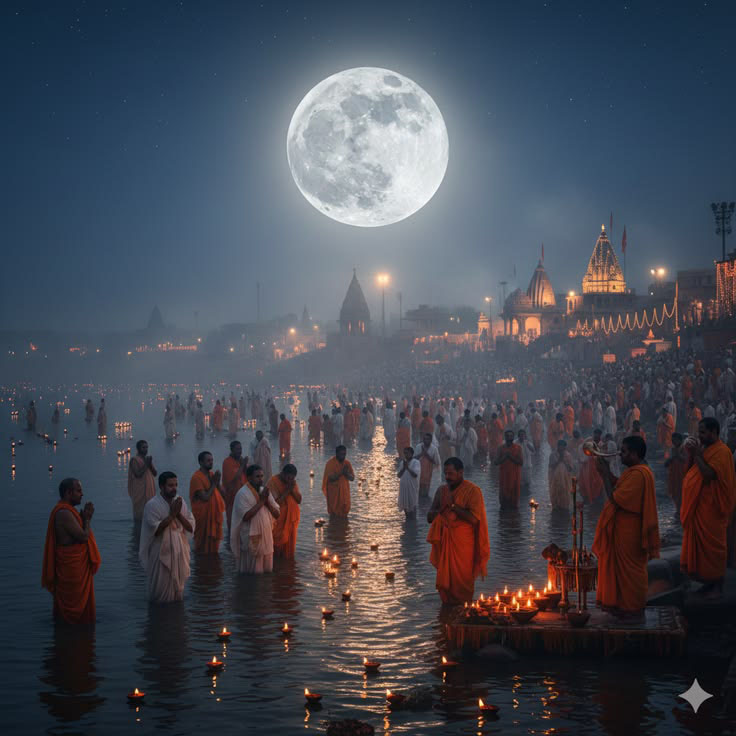
The full moon is one of the most important days in the Himalayan calendar. In Nepal it is called Purnima, and almost every month's Purnima has its own festival.
- In Buddhism, tradition holds that the Buddha was born, reached enlightenment and passed away on a full moon. That day is kept as Buddha Purnima. Full moon days are also observance days, when monasteries hold longer meditation and chanting.
- In Hinduism, Purnima is a day for fasting, prayer and honouring teachers. Guru Purnima, the full moon dedicated to one's teachers, is one of the best known.
- In both, the full moon stands for completion and clarity: the moment when the moon is whole and its light is at its brightest.
So a bowl made on that night is tied to a day people already keep for meditation and reflection. That is the meaning it carries.
How full moon singing bowls are made
A full moon bowl is made the same way as any hand-hammered singing bowl. The alloy is poured into a small thick disc. The disc is heated until it glows and is hammered by a team of smiths working in turn, then reheated and hammered again, many times, until the wall rises and the bowl takes its form. Our page on hand-hammered singing bowls describes each step.
What changes is the schedule. The smiths plan the work so that the forging falls on the night of the full moon, and they work through that night. In Nepal the modern practice of making singing bowls on the full moon is widely credited to the Kathmandu Valley craftsman Santa Ratna Shakya, who comes from a family of metalworkers and helped make the idea known.
One point matters for anyone choosing a note. A hand-hammered bowl's note is discovered once the bowl is finished. No smith can hammer toward a target note, on a full moon or any other night. A bowl is played and judged only after all the work on it, including any engraving, is complete.
The seven metals and the moon
Himalayan singing bowls are traditionally described as a seven-metal alloy, sapta dhatu. Copper and tin make up almost all of the metal, with iron, zinc, lead, silver and gold spoken of in small amounts. In the traditional telling each metal is linked to a heavenly body, and silver is the metal of the Moon. That link is part of why the full moon and the singing bowl are thought to belong together.
For what each metal does to the sound, and what has been measured, read the seven metals in a singing bowl.
Does a full moon bowl sound different?
The honest answer is that the metal and the method are the same, so we do not claim a difference you could measure. A full moon bowl has the warm, layered tone and long sustain of any well-made hand-hammered bowl, and every hand-hammered bowl sounds a little different from the next.
Tradition says a bowl made under the full moon carries its energy. That is a belief, and many practitioners hold it sincerely. What is a fact is the timing of the forging. Our post on full moon singing bowls, myth and truth looks at this question in more detail.
See our full moon singing bowls
Hand-hammered in Nepal on full moon nights, in classic and Jhumka forms. Each one is played and chosen for your order before it ships.
Benefits: what people use a full moon bowl for
People use a full moon singing bowl for the same things as any singing bowl, with the added meaning of the day it was made.
- Meditation. The long tone gives the mind one steady thing to rest on.
- Relaxation. Many people find the sound and the slow rhythm of playing calming at the end of a day.
- Full moon practice. Playing the bowl on Purnima as part of a monthly ritual. See singing bowl rituals for the moon phases.
- Sound healing sessions. In the Jhumka form, with its thick wall, the vibration can be felt through the body.
- Marking a date. A bowl made on, or engraved with, the full moon of a birth, a wedding or a memorial.
Sound work of this kind supports relaxation and meditation. It does not replace medical care.
Can crystal or cast bowls be full moon singing bowls?
Not in the traditional sense. A crystal singing bowl is made from quartz in a modern factory process, and the full moon tradition belongs to Himalayan metalwork. See metal vs crystal singing bowls for how the two differ.
A cast bowl is poured into a mould. The full moon tradition is about a night of hand hammering, so a genuine full moon bowl is hand-hammered.
How to tell if a full moon bowl is genuine
You cannot tell by looking at the bowl or by listening to it. A bowl made on the full moon and one made a week later look and sound alike. What you are relying on is the maker's word. So ask the seller three things: who made the bowl, whether the workshop really schedules forging to the lunar calendar, and whether they can tell you which full moon it came from. A seller who works directly with the smiths can answer. One who buys from a wholesaler usually cannot.
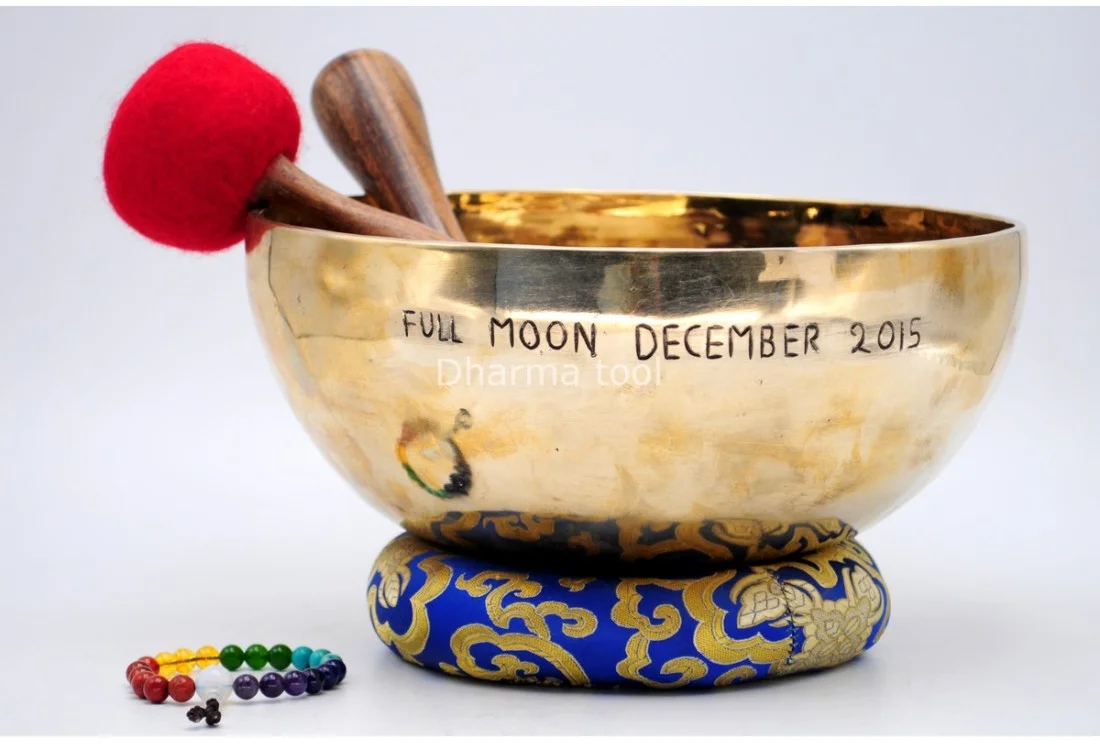
Have a full moon date engraved
Choose the full moon nearest a birth, a wedding, an anniversary or a memorial, and we engrave that date on your bowl by hand, at no extra cost.
How to use a full moon singing bowl
- Strike it. Hold the bowl on a flat palm or set it on its cushion. Tap the outside wall gently with the mallet and let the tone open and fade.
- Sing it. Press the mallet against the outside of the rim and move it slowly around, with steady pressure, until the tone builds.
- Use it on the full moon. Sit somewhere quiet on the night of Purnima, strike the bowl three times, and follow each tone to silence.
If you are new to this, start with how to play a singing bowl, and for more, our free singing bowl healing course covers technique and session structure.
Why full moon singing bowls are less common
There is only one full moon a month, and a workshop has to keep working on the other nights. Only a small share of its bowls can be made on the full moon. That makes them less common than ordinary bowls, and it is why trade orders for them have to be planned months ahead.
Frequently asked questions
What is the meaning of a full moon singing bowl?
It is a singing bowl made on the night of the full moon, a day that stands for completion, clarity and a calm mind in Hindu and Buddhist tradition. The bowl is understood to carry that meaning.
What is a full moon singing bowl?
A Himalayan singing bowl hand-hammered on the night of a full moon, using the same seven-metal alloy and method as any other hand-hammered bowl.
What is Purnima?
Purnima is the Nepali and Sanskrit word for the full moon day. It is kept as a day of prayer, fasting and meditation in both Hinduism and Buddhism.
Who started the full moon singing bowl tradition?
The modern practice of making singing bowls on the full moon is widely credited to Santa Ratna Shakya, a craftsman from the Kathmandu Valley in Nepal.
Does a full moon singing bowl sound different from a regular one?
The metal and the method are the same, so no measurable difference is claimed. People choose a full moon bowl for the tradition and the meaning of the day it was made.
What are the benefits of a full moon singing bowl?
People use one for meditation, relaxation, monthly full moon practice and sound healing sessions, and to mark a date such as a birth or a wedding.
Can crystal or cast bowls be full moon singing bowls?
Not in the traditional sense. The full moon tradition belongs to hand-hammered metal bowls from the Himalayas.
How can I tell if a full moon singing bowl is genuine?
You cannot tell from the bowl itself. Ask the seller who made it, whether the workshop schedules forging to the lunar calendar, and which full moon the bowl came from.
Can I have a full moon date engraved on a bowl?
Yes. A specific full moon date, a name or a mantra can be engraved by hand, and at Dharma Tool the engraving is free.