



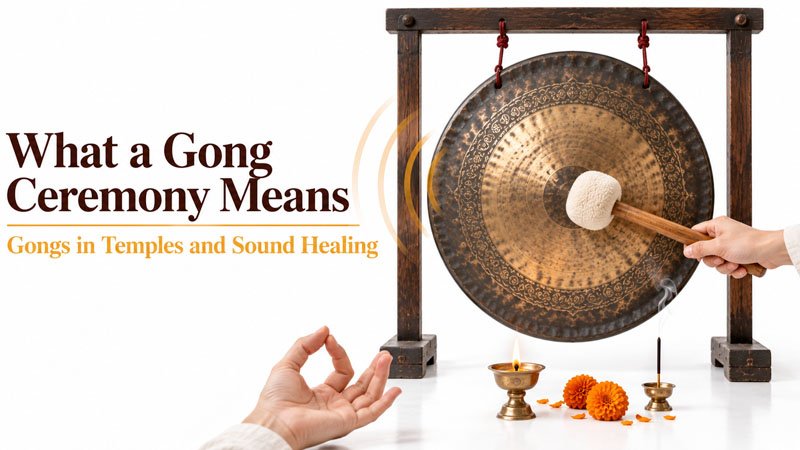
What a Gong Ceremony Means - Gongs in Temples and Sound Healing
A gong ceremony is any ritual in which a gong is struck to mark a moment: to open or close it, to call people together, or to carry a prayer. In Buddhist temples gongs call monks to prayer, meals and assembly, and in Vietnam and Java a spirit is believed to live in the gong itself. In sound healing today, a gong ceremony is a guided session that opens with an intention, rests in the sound of the gong and ends in silence.
Key takeaways
- Meaning: a gong marks a threshold: a beginning, an ending or a call.
- Temples: gongs keep the rhythm of monastery life, and some temples strike the gong 108 times morning and evening.
- Sacred gongs: in Vietnam and Java, a gong is honoured as the home of a spirit.
- Celebrations: weddings, festivals and openings, from old Chinese processions to the Hong Kong stock exchange.
- Sound healing: an intention, the sound of the gong, then silence.
What is a gong ceremony?
A gong ceremony is a ritual or event in which a gong is struck on purpose to mark a moment. The strike might open a prayer, gather a village, honour the dead, bless a harvest or open a new business.
What is a gong?
A gong is a round metal percussion instrument, usually bronze or brass, that hangs freely and is struck with a padded mallet to give a deep, ringing sound. Flat gongs, such as the chau gong and the wind gong, give a wide wash of sound, while bossed gongs have a raised centre and ring with a clearer note.
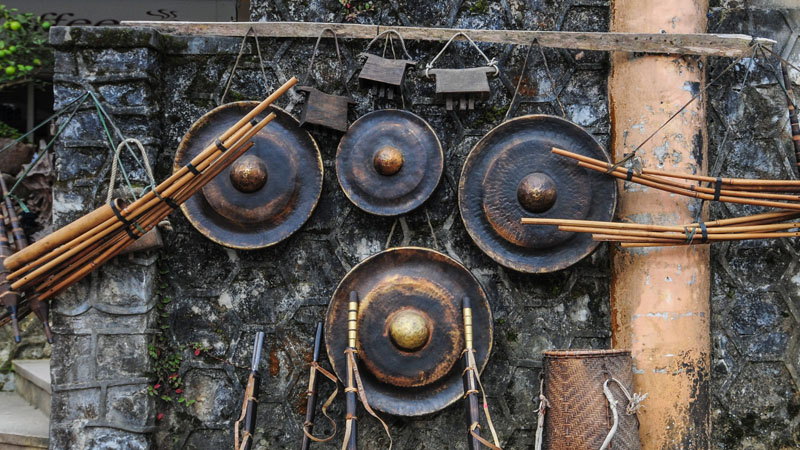
The gong is one of the oldest ceremonial instruments in Asia. A bronze drum from Vietnam's Dong Son culture, made more than 2,000 years ago, may show the earliest picture of gongs, and Chinese records describe them about 1,500 years ago (history of the gong). The word itself comes from Malay and Javanese and imitates the instrument's sound (Merriam-Webster).
Today you hear gongs in temples, at festivals and openings, and in yoga studios and sound healing rooms, where a hand-forged Tibetan gong often leads the ceremony.
Gong meaning: what does a gong symbolise?
Gong symbolism is remarkably similar across cultures. A gong's long, rising sound carries far and lingers in the air, so it is used to mark the line between before and after.
| What a gong marks | What the strike does |
|---|---|
| A beginning | The first strike opens a ceremony, a meditation or a day's work |
| An ending | A final strike closes a ritual, a session or a round |
| A call | Its voice carries far, gathering people to prayer, meals or meetings |
| A voice to the sacred | In many traditions its sound is believed to reach gods, spirits or ancestors |
| A clearing | A strong strike is felt to clear the air, and the mind, before something new |
| Honour and protection | Old gongs are kept as heirlooms and as a sign of a family's standing |
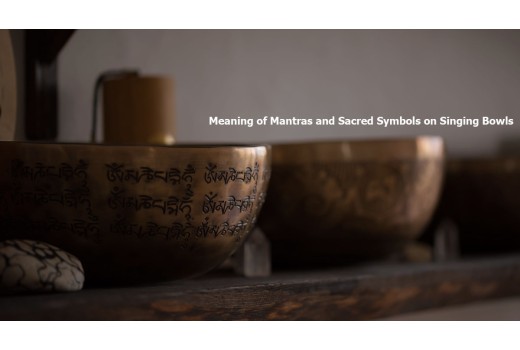
Carved gongs add their own meaning. A gong carved with the sacred syllable OM, like our Tibetan OM Carved Gong, carries that prayer with every strike.
How are gongs used in Buddhist temples?
In Buddhist monasteries, struck instruments keep the rhythm of the day. In Tibetan monasteries, a long wooden gong called the gandi is beaten to call monks and nuns to their regular ceremonies and to work, and to mourn a monk who has died (Rangjung Yeshe dictionary).
In Chinese and Japanese Zen temples, a flat bronze "cloud plate", called yunban in Chinese and umpan in Japanese, hangs near the kitchen and is struck for meals and at the end of meditation (umpan). In Japan, a dora gong is also sounded at Buddhist memorial services.
In Myanmar, every monastery has a wooden gong to call the monks together (Insight Myanmar), and bronze gongs hang in temples to announce the important moments of the day. Across Southeast Asia, bossed gongs are still played in Buddhist temples.
At Nan Tien Temple in Wollongong, Australia, the gong and drum open and close each day, at 6am and 4:30pm. The gong is struck 108 times, a number linked to the 108 kinds of worry that trouble all beings, and its sound is believed to clear them away. During chanting, a bowl-shaped bell is struck three times in a row to help everyone settle their minds (Nan Tien Temple).
Where are gongs sacred?
In the Central Highlands of Vietnam, the gong is the main instrument of community ritual, from the blessing of rice to mourning rites. Every family owns at least one gong as a sign of wealth and protection, and UNESCO notes that "behind every gong hides a god or goddess" whose power grows as the gong ages (UNESCO).
Among the K'Ho people, a gong worship ritual is held before festivals, sowing, house building and weddings. The village offers rice, fish, chicken and liquor and asks the gong spirits for permission to play (Vietnam Tourism).
In Java and Bali, the largest gong of the gamelan, the gong ageng, marks the end of each long musical phrase, and the spirit of the whole gamelan is said to live in it. Offerings of flowers, food or incense are made to it before performances (gong ageng), and UNESCO added gamelan to its list of intangible heritage in 2021 (UNESCO).
In the southern Philippines, rows of bossed gongs are the heart of kulintang music. In each of these places the gong is far more than an instrument: it is a family treasure and a link to the unseen.
How are gongs used in celebrations?
In old China, gongs led state processions, weddings and festivals. Attendants beat gongs to clear the road for officials, and the number of strokes could show how senior the official was.
Gongs still drive the lion dance at Chinese New Year and mark entrances and dramatic moments in Chinese opera. In Hong Kong, companies can strike a gong at the stock exchange to open or close the trading day, often to celebrate a new listing or an anniversary (HKEX).
In Britain, a dinner gong once called guests to meals in grand houses, hotels and ships. The word even became slang: to "get a gong" is to receive a medal or an honour.
What is a gong ceremony in sound healing?
In yoga and sound healing, a gong ceremony is a guided session for rest and reflection, usually lying down. Many are held at the new moon or full moon, at the new year, or to mark a fresh start such as a birthday or a new home.
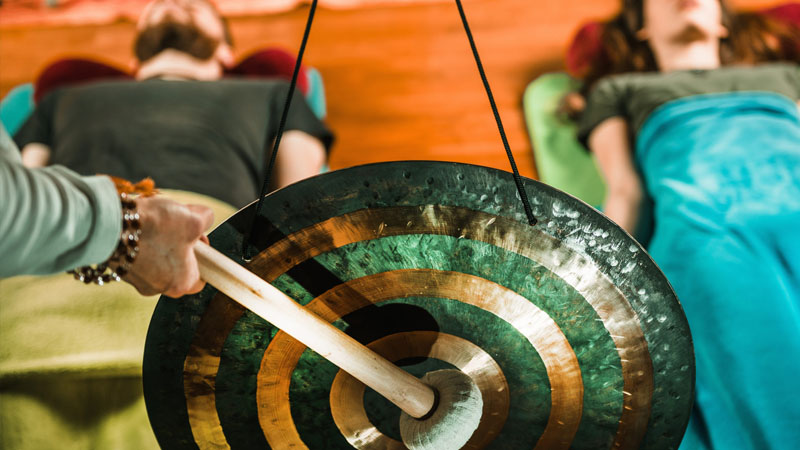
| Part | What happens |
|---|---|
| Opening | A welcome, a few slow breaths and a quiet intention |
| First strikes | One or a few soft strikes to open the space |
| The journey | The gong is played softly, rising to a full wash, then easing down |
| Silence | Everyone rests as the last sound fades |
| Closing | A final soft strike, a moment of thanks and a glass of water |
Unlike a temple ritual, a sound healing gong ceremony is usually not tied to one religion, so anyone can take part. A gong ceremony supports relaxation and focus, and does not treat any condition.
Keep the gong soft, and check with a doctor first if you are pregnant, have epilepsy or have an implant. Volume, set-up and safety are covered in our guide to a gong bath at home.
How do you hold a simple gong ceremony at home?
- Choose the moment: a new moon, the new year, a move into a new home or the start of a practice.
- Prepare the space: tidy the room, light a candle, and sit or lie comfortably.
- Set an intention in a few words, such as "a fresh start" or "gratitude".
- Open with three soft strikes, letting each one fade before the next.
- Play gently for 10 to 20 minutes, or sit with single strikes and the silence between them.
- Close with a final soft strike, a minute of silence and a word of thanks.
If you are new to the gong, our guide on how to play a gong shows how to wake it and build a soft, even sound.
What do the carvings on a Tibetan gong mean?
Many Tibetan gongs carry carved or etched symbols that add meaning to a ceremony, such as OM, mantras or a mandala. Each one is explained in our guide to Tibetan gong carvings and their meaning.
Which gong suits a ceremony?
For openings and temple-style ceremonies, choose a gong with a clear, strong voice; for sound healing ceremonies, a deep, warm gong played softly. A chau gong or hand-forged Tibetan gong of 20 to 28 inches suits most rooms, and a large temple gong fills a hall. The differences are in our guides to types of gongs and gong sizes.
Our gongs are hand-forged in Nepal and come with a soft felt striker, and most with a wall-hanging setup.
Choosing a gong for ceremony?
Our Mantra Carved Tibetan Gong is carved with mantras across its face, a gong made for prayer, ceremony and sound healing, hand-forged in Nepal.
| If you want | Look at |
|---|---|
| A gong carved with mantras | Mantra Carved Tibetan Gong, 13 to 22 inches |
| The sacred syllable OM | Tibetan OM Carved Gong, 13 to 22 inches |
| Mantras etched into the metal | Tibetan Mantra Etched Gong |
| A deep gong for sound ceremonies | Chau Gong with Flower of Life mandala, 16 to 26 inches |
| A large gong for halls and temples | Extra Large Temple Gong, 20 to 39 inches |
Every gong is in Tibetan gongs, and you can have one made in your size and design on our custom gong page.
Frequently asked questions
What is a gong ceremony?
A gong ceremony is a ritual or event in which a gong is struck to mark a moment, such as opening a prayer, calling people together or closing a session. Temples, festivals, weddings, business openings and sound healing sessions all have their own gong ceremonies.
What is a gong?
A gong is a round metal percussion instrument, usually bronze or brass, that hangs freely and is struck with a padded mallet. It gives a deep, ringing sound that builds and lingers.
What does striking a gong mean?
Most often it marks a beginning, an ending or a call to gather. In many traditions the sound is also believed to carry a prayer or to reach the gods, spirits or ancestors.
What is the spiritual meaning of a gong?
In many traditions a gong's sound marks a threshold and is believed to carry prayers, call the spirits or clear the mind. In Vietnam and Java a spirit is said to live in the gong itself, and in Buddhist temples its sound is meant to wake and settle the mind.
What is a gong used for?
Gongs mark ceremonies, call people together and keep time in temples and music. They are also used for signals, in orchestras, and for meditation and sound healing.
Why do Buddhist temples use gongs?
To keep the rhythm of monastery life. Gongs and wooden gongs call monks and nuns to prayer, meals, work and assembly, and in Japan a gong is sounded at Buddhist memorial services.
Why is a temple gong struck 108 times?
In Chinese Buddhist temples, 108 is an auspicious number linked to the 108 kinds of worry that trouble all beings. At Nan Tien Temple in Australia, the gong is struck 108 times each morning and evening to help clear them away.
Why is a gong struck three times?
There is no single rule, but three strikes are a common way to open. In Chinese Buddhist chanting, a bowl-shaped bell is struck three times in a row to help people settle their minds, and a gong ceremony can open the same way.
What does a gong mean in Chinese culture?
Gongs stand for celebration and authority. They led processions, weddings and festivals, cleared the road for officials, and still drive the lion dance and Chinese opera.
Why is a gong struck at the Hong Kong stock exchange?
To open or close the trading day at a market ceremony. Companies often take part to celebrate a new listing, an anniversary or another milestone.
Is a gong ceremony religious?
It can be. In temples, and in the gong rituals of Vietnam and Java, it is part of religious life, while a sound healing gong ceremony is usually open to people of any belief.
What happens at a sound healing gong ceremony?
You lie or sit comfortably, set an intention and rest while the gong is played softly, rising to a full sound and easing down. The ceremony ends in silence and a final soft strike.
Can I hold a gong ceremony at home?
Yes. Choose a moment such as a new moon or the new year, set an intention, open with three soft strikes, play gently for 10 to 20 minutes and close in silence.
What is the big gong in a gamelan called?
The gong ageng. It is the largest gong in Javanese and Balinese gamelan, marks the end of each long musical phrase, and the spirit of the whole gamelan is said to live in it.
Ready to bring a gong into your ceremonies?
Every gong is hand-forged in Nepal and comes with a soft felt striker.