




Handled, Chalice and Hanging Singing Bowls - How Each One Is Played
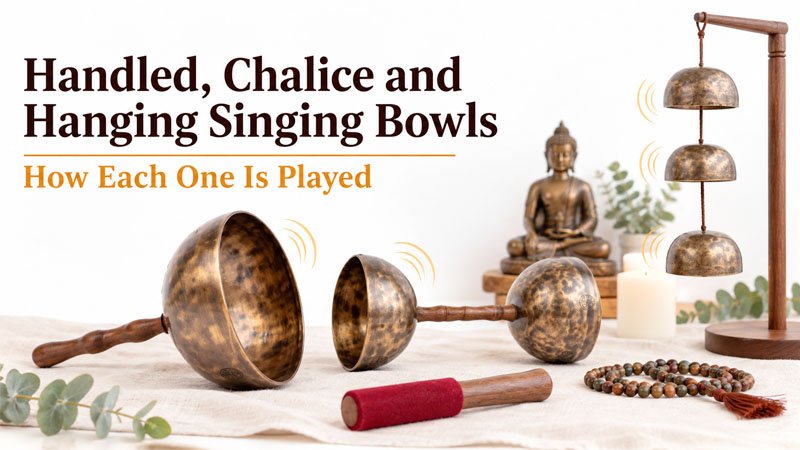
A handled singing bowl sits on a wooden handle fixed under its base, so you hold it in the air and it rings freely. A double chalice joins two bowls base to base on one handle, and a hanging chime strings three bowls on a cord. All three are struck on the wall, the handled bowl can also be rimmed, and you can move the sound as you play.
Key takeaways
- Handled bowl: one bowl on a handle; strike or rim it in the air.
- Double chalice: two bowls on one handle; strike one, then the other.
- Hanging chime: three bowls on a cord; strike top to bottom for a cascade.
- Why it helps: the base touches nothing, so the bowl rings freely and the sound can move with you.
What are handled, chalice and hanging singing bowls?
| Form | How it is built | Sizes | How you play it |
|---|---|---|---|
| Handled bowl | One hand-hammered bowl on a turned wooden handle | 7 to 12 inches | Strike or rim, held in the air |
| Double chalice | Two bowls fixed base to base on one handle | Pairs from 6+7 to 9+10 inches | Strike one bowl, then the other |
| Hanging chime | Three bowls strung one above the other on a cord | Trios from 5+6+7 to 7+8+9 inches | Strike each bowl as it hangs |
All three are hand-hammered in Nepal, like the bowls in our hand-hammered singing bowls. What changes is how you hold them, which changes how you can play them.
Why play a bowl off the ground?
- It rings freely: the base touches only a handle or a cord, never a table or a hand.
- The sound can move: tilt the bowl to aim the sound, or carry it around a room.
- No cushion needed: you play it in the air, so you can stand, walk or sit anywhere.
A footed bowl gives some of the same freedom; see our Naga pedestal bowl guide. To learn the parts of any bowl, read the anatomy of a singing bowl.
How do you play a handled singing bowl?
- Hold it level by the handle, with a relaxed grip.
- Strike the outer wall with the felt mallet for a warm, round note.
- Rim: press the wooden mallet to the outer rim and move it in a slow, even circle until the bowl sings.
- Move it: tilt the bowl or carry it slowly; keep the motion smooth so the note stays steady.
Which mallet does what is explained in wooden mallet vs felt striker. For the basics, read how to play a singing bowl in our free course.
Want a bowl you can play in the air?
Our handled bowl comes in 7 to 12 inches, in the chakra note you choose, with a felt mallet and a wooden mallet. Sunita chooses yours after your order arrives.
How do you play a double chalice or a hanging chime?
- Double chalice: hold it level by the central handle, strike one bowl with the felt mallet, let it ring, then strike the other. Tilt either bowl to aim its sound.
- Hanging chime: hang it from a hook or stand so all three bowls hang free, then strike each wall with the felt striker for a warm tone or the wooden striker for a brighter one.
- Order: top to bottom on the chime gives a falling cascade; bottom to top gives a rising one.
Two notes sounding together is explained in playing two singing bowls together.
Which notes can you choose?
| Bowl | Your choice | Example |
|---|---|---|
| Handled bowl | One chakra note, C to B | Heart, F |
| Double chalice | A pair; the larger bowl takes the lower note | Earth and Sky: Root C with Crown B |
| Hanging chime | A trio; the bottom bowl takes the lowest note | Body, Heart, Spirit: Root C, Heart F, Crown B |
Each note is matched as closely as a handmade bowl allows. Check yours with our free live singing bowl tuner.
How are they used around a person or a room?
- Around a person: with a handled bowl, the sound can be carried slowly around someone lying down, without the bowl touching them.
- Through a room: walk the handled bowl from corner to corner, as in how to cleanse a room with a singing bowl.
- At home: hang the chime where you pass, and strike it to mark the start of your practice.
A singing bowl supports relaxation and does not treat any condition.
Which one should you choose?
- Choose the handled bowl to move the sound around a room or a person.
- Choose the double chalice for two notes in one hand, such as Root and Crown.
- Choose the hanging chime for a cascade of three notes and a piece that hangs on show.
All three come in Shining, Golden Dim, Antique (Tiger Eye) or Full Moon finishes, and engraving is free. For a design of your own, use our custom singing bowl page.
Frequently asked questions
How do you play a singing bowl with a handle?
Hold it level by the handle. Strike the outer wall with the felt mallet, or press the wooden mallet against the outer rim and move it in an even circle to make it sing.
Why does a singing bowl have a handle?
The handle keeps the base off any surface, so the bowl rings freely, and it lets you tilt the bowl or move the sound around a room or a person.
What is a double chalice singing bowl?
It is two bowls of different sizes fixed base to base on one wooden handle. The larger bowl gives the lower note, so you hold two notes in one hand.
How do you play a hanging singing bowl chime?
Hang it so all three bowls hang free, then strike each wall with the felt or wooden striker. Top to bottom gives a falling cascade, bottom to top a rising one.
Can I choose the notes?
Yes. Choose a chakra note for the handled bowl, a pair of chakras for the double chalice, and a set of three for the hanging chime.
Do I need a cushion for a handled bowl?
No. A handled bowl is played in the air, held by its handle, so it does not need a cushion while you play.
Can a handled bowl be engraved?
Yes. Engraving is free on all three: a name, a short message, initials or a mantra.
Two notes in one hand
Choose your size pair and chakra pair, from Grounded Heart to Earth and Sky. Engraving is free.