




Is It You or the Singing Bowl? How to Tell if a Bowl Actually Has a Fault
Short answer: in our experience it is the technique roughly nine times out of ten, and a genuine fault the other one. There is a two-minute test that separates them, and you should run it before doing anything else.
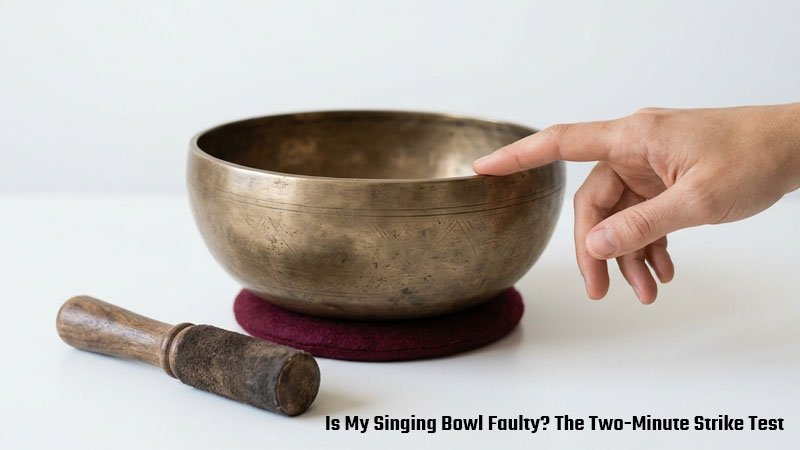
The test: set the bowl on a cushion, strike it once on the outer wall with a padded mallet, and listen to the whole tone until it dies.
- Clean, steady, rings on for several seconds — the bowl is fine. The problem is in how you are rim-playing it, which is a fixable technique issue.
- Buzzes, wavers, or dies in under two seconds — something is wrong with the bowl, what it is sitting on, or both. This article covers which.
Striking removes every variable that rim-playing introduces. If a bowl strikes well, nothing is broken.
First: rule yourself out
Almost everyone who contacts us convinced they have a faulty bowl is holding it wrong or circling too fast. That is not a criticism — nobody is born knowing how to rim-play, and the technique is genuinely counter-intuitive.
Before reading any further, work through the five technique causes in Lesson 1.2 of our free course: fingers touching the wall, circling too fast, too little pressure, the wrong mallet end, and a bowl too large to hold. Those five account for the overwhelming majority of silent bowls, and all five are free to fix.
Come back here if you have done all of that and the bowl still will not behave.
One the course does not cover: rings and bracelets
Metal on your hands will ruin the sound, and almost nobody thinks of it. This is the cause we most often have to point out, and it is invisible to the person doing it because their hands feel perfectly normal.
Three things happen:
- A ring on the hand holding the bowl touches the outer wall and damps it, exactly as a finger does — except you are unaware of it, because you have flattened your palm correctly and the ring is doing the damage on its own.
- A ring on the mallet hand clips the rim as you circle, producing a small metallic tick once every revolution. People hear a regular click under the tone and assume the bowl is cracked.
- Bracelets and bangles swing. Stacked bangles are common among practitioners and yoga teachers, and they tap the wall at irregular intervals — which sounds far more alarming than a steady tick, because the rhythm makes no sense.
Here is the useful diagnostic. A tick caused by jewellery and a tone that drops out from a rim dent can sound similar, and they are easy to confuse. The difference is what the fault is attached to.
- A rim dent fails at the same point on the bowl. Rotate the bowl in your hand and the fault rotates with it.
- Jewellery ticks at the same point in your hand's rotation. Rotate the bowl and the tick stays where it was, because it is travelling with you rather than with the metal.
Also worth checking: a watch on the mallet wrist can catch the rim of a large bowl, and long fingernails will tap the wall of a bowl held on the palm.
Take everything off before you play. It costs nothing to test, it resolves the problem more often than people expect, and there is a second reason to do it — metal on metal scratches a bowl, and a ring worn over years will wear a visible line into the rim.
And the other one: thick bowls take far longer than you think
A heavy bowl can need twenty seconds of continuous rimming before it makes any real sound. Most people give up at five. This is the second cause we most often have to explain, and like the jewellery it is invisible to the person doing it — everything they are doing is correct, they are simply stopping too soon.
The reason is mass. Rim-playing works by feeding energy into the metal a little at a time, and a thick wall needs far more of it before the vibration takes hold. A thin bowl reaches a full tone in two to four seconds. A heavy therapy bowl, a Jhumka, or anything above about ten inches can take twenty to thirty.
What it feels like. Before you hear anything, you will feel a faint vibration coming back through the mallet handle. That is the signal to keep going, not to stop. It means the bowl is taking the energy — you simply have not reached the threshold where it becomes audible. If you feel that and stop, you will conclude the bowl is dead when it was about to sing.
Four things to do differently on a heavy bowl:
- Keep going for a full thirty seconds before drawing any conclusion. Count it, because five seconds of nothing feels much longer than it is.
- Hold the pressure and the speed constant. The instinct when nothing happens is to speed up, and speeding up is exactly what produces the chatter and scrape people then blame on the bowl. Slow and firm, all the way through.
- Do not lift the mallet to check. Every break costs you everything you have built, and you start again from nothing.
- Use a heavier mallet. A small wooden striker cannot drive a large wall, no matter how long you persist. A thicker suede mallet with more surface contact is the difference between difficult and impossible.
Once it does arrive, it arrives suddenly and it is loud. Ease the pressure off at that point and simply maintain it. Our post on why a singing bowl takes time to sing goes into the technique in more depth.
Fault 1: It is not the bowl, it is what the bowl is sitting on
A bowl set directly on a hard surface will buzz, and the buzz sounds exactly like a cracked bowl. This is the single most common false alarm we deal with.
Bronze rings by vibrating, and the base of a bowl vibrates along with everything else. Set it on glass, tile, stone or a hard wooden table and the base chatters against the surface — a fast, dry rattle underneath the tone. People hear it, assume the metal is damaged, and stop playing.
How to test it. Hold the bowl on a flat open palm, or set it on a folded cloth, and strike it again. If the buzz disappears, there is nothing wrong with your bowl.
A proper ring cushion solves it permanently, and is worth having anyway — they are in singing bowl accessories. A folded tea towel works in the meantime.
Two related culprits worth checking: something inside the bowl, even a grain of rice or a stray bead, will rattle audibly; and a loose table can resonate sympathetically, which sounds like the bowl even though it is the furniture.
Fault 2: A flat spot on the rim
If the bowl sings on part of the rim and stops in the same place every circuit, it has taken a knock. This is a real fault, it is common in secondhand and antique bowls, and it is the most frequently missed diagnosis.
A dent or a flattened section changes the wall geometry locally. The mallet loses even contact as it passes, the vibration breaks, and the tone drops out — always at the same point. People usually blame their own technique for this, because the bowl clearly can sing, just not all the way round.
How to test it. Rim-play slowly and note exactly where the sound fails, then stop and look at that section against the light. Run a fingertip round the outside of the rim with your eyes closed — the hand finds a flat spot the eye misses.
Can it be fixed? Sometimes. A shallow dent can be worked out by a smith, though the bowl's pitch may shift slightly afterwards. A sharp crease or a folded rim usually cannot be corrected without ruining the tone. This is also why we ask about rim condition on every antique bowl we sell, and why it is the first thing to ask about when buying one secondhand.
Fault 3: The wall is simply too thin
Some bowls physically cannot hold a sung tone, and no technique will make them. This is the honest answer for a large share of cheap bowls, and it is not something you can fix.
A machine-pressed or spun brass bowl has thin, perfectly even walls. It will strike and give a bright chime, but there is not enough mass to keep vibrating once the mallet has passed, so the rim tone dies as fast as you build it. Brass compounds this: it is copper and zinc rather than copper and tin, and it produces far fewer overtones and much shorter sustain than bell-metal bronze.
How to test it. Feel the weight against the size. A 6-inch bowl that feels light for its diameter is thin-walled. Then strike it and count: a properly made bowl of that size rings for well over five seconds, a thin one for one or two. Flick the rim with a fingernail — bronze gives a note, thin brass gives a tink.
If this is your bowl, nothing is broken and nothing is your fault. It is a decorative object rather than an instrument. Our post on why every singing bowl sounds different explains what hand-hammering does that pressing cannot.
Fault 4: A crack you can hear before you can see
A hairline crack changes the decay long before it becomes visible. This is the fault people most fear and least often actually have — but when it is present, it is permanent and it will spread.
What you hear is a tone that starts normally and then breaks — a sudden buzz partway through the decay, or a note that sounds like two slightly different pitches beating against each other. It is not the steady rattle of a bowl on a hard table; it is a change that happens during the ring.
How to test it. Suspend the bowl properly — balanced on three fingertips of a flat hand, nothing touching the wall — and strike it. A sound bowl gives one clean decay. A cracked one gives a tone that fractures. Then work slowly round the rim with a fingertip and a raking light, paying attention to the base and the lower wall, where stress concentrates. Cracks usually start at the rim or radiate from the base.
Can it be fixed? No. Welding or filling a bowl changes the mass and the wall stiffness locally, which destroys the tone even if it holds the metal together. A cracked bowl can still be a beautiful object and can still be struck, but it will not sing properly again, and the crack will grow with use.
Fault 5: It sang before, and now it does not
If a bowl has changed, something about the situation has changed — and it is almost never the metal. Bronze does not degrade sitting on a shelf.
Work through these in order:
- The mallet. This is the answer most of the time. Suede and leather wear smooth and polish with use, and a polished mallet cannot grip the rim. It is a consumable, not a permanent fitting. Try a different one before suspecting the bowl.
- Something on the rim. Hand cream, polish residue, oil from fingers, furniture wax. Any of it destroys the friction the technique depends on. Wipe the outer rim with a dry cloth, and if you have polished the bowl, that is very likely your answer.
- Someone polished it. Metal polish leaves a microscopically slick surface and fills any carved lines. See cleansing and charging a singing bowl for what is safe.
- A new surface. Moved to a different table, different cushion, different room. See Fault 1.
- Your hands. Cold hands grip differently, and dry versus damp skin changes how the mallet sits. Trivial, and occasionally the whole explanation.
- It was knocked. If it was dropped or hit anything, go back to Fault 2 and check the rim.
Fault 6: The bowl is fine and the expectation is wrong
Some bowls are not meant to sustain on the rim, and a few are not meant to be rim-played at all. Worth knowing before you conclude anything is wrong.
- Very small bowls — under about four inches, sustained rim tone is genuinely difficult and sometimes impossible. They are made to be struck.
- Thick therapy and Jhumka bowls — deliberately heavy-walled for body vibration. They take much more effort and a heavier mallet to start singing, and they are not the ones to learn on.
- Heavily carved bowls — deep relief changes how a mallet travels. Most players find it helps once they are used to it, but it feels different at first.
- Bowls with a handle or on a stand — played by striking, not rimming.
- Low-note large bowls — the tone takes several seconds to build. People give up before it arrives. Our post on why a singing bowl takes time to sing covers this.
Which faults can be repaired?
| Symptom | Likely cause | Repairable? |
|---|---|---|
| Dry rattle under the tone | Hard surface underneath | Not a fault — use a cushion |
| Regular metallic tick once per circuit | Ring, bracelet or watch on the playing hand | Not a fault — take it off |
| Sound drops out at the same point | Flat spot or dent on the rim | Sometimes, by a smith; pitch may shift |
| Nothing happens while rimming a heavy bowl | Stopping before the tone builds | Not a fault — keep going 30 seconds |
| Strikes brightly, will not sustain | Wall too thin, often brass | No — it is how the bowl was made |
| Tone fractures partway through the decay | Hairline crack | No |
| Worked before, stopped recently | Polished mallet or residue on the rim | Yes — new mallet, wipe the rim |
| Two pitches beating together | Crack, or two bowls resonating nearby | Move other bowls first, then see above |
| Very short ring on a small bowl | Nothing — it is a striking bowl | Not a fault |
The pattern worth noticing: the cheapest problems are the most common ones. A cushion and a fresh mallet resolve more complaints than anything else, and neither costs much.
Not sure what you are hearing?
Send us a short video of the bowl being struck and rim-played, wherever you bought it. We will tell you honestly whether it is technique, the surface, or a genuine fault. No charge, and we will say so if the bowl is fine.
What if it turns out the bowl is genuinely faulty?
If you bought it from us, tell us — that is what our returns policy is for, and a bowl that will not sing is not a bowl we want in anyone's hands.
If you bought it elsewhere and it cannot be repaired, the useful thing is to know what to avoid next time. Three things separate a bowl that sings easily from one that fights you:
- Enough wall. Weight for its size is the simplest proxy. A hand-cast bowl has an even wall and is the easiest kind to learn on; a hand-hammered bowl has more complex overtones and rewards a settled technique.
- An undamaged rim. Ask specifically. Sellers describe tone and finish and rarely mention rim condition.
- Someone who has played that exact bowl. A stock photo and a generic description tell you nothing about whether the thing sustains. Every bowl we sell is tuned and played by a sound healer before it ships, and we will record the one you are considering before you buy — which is why we do not publish stock sound clips.
And if none of the standard options fit what you need, a custom singing bowl lets you set the diameter, the wall weight, the note and the finish — which is the route most practitioners take once they know exactly what they are after.
Frequently asked questions
How do I know if my singing bowl is faulty or if it is my technique?
Strike it once on the outer wall with a padded mallet, with the bowl on a cushion, and listen to the whole tone. A clean tone lasting several seconds means the bowl is fine and the problem is rim technique. A buzz, a waver, or a tone that dies in under two seconds points to the bowl, the surface it sits on, or both.
Why does my singing bowl buzz or rattle?
Most often because it is sitting on a hard surface and the vibrating base is chattering against it. Hold it on a flat palm or set it on a folded cloth and strike again — if the buzz stops, nothing is wrong. Also check for anything loose inside the bowl.
How can I tell if my singing bowl is cracked?
Listen rather than look. A cracked bowl produces a tone that starts normally and then fractures partway through the decay, often sounding like two slightly different pitches beating against each other. Balance the bowl on three fingertips with nothing touching the wall, strike it, and listen to the full ring. Then examine the rim and the lower wall under raking light.
Can a cracked singing bowl be repaired?
No. Welding or filling changes the mass and wall stiffness locally, which destroys the tone even if the metal holds. A cracked bowl can still be struck and remains a beautiful object, but it will not sing properly again and the crack will spread with use.
Can a ring or bracelet stop a singing bowl working?
Yes, and it is one of the most commonly missed causes. A ring on the holding hand damps the wall even when your palm is flat. A ring on the mallet hand clips the rim once per revolution, producing a tick people mistake for a crack. Bangles swing and tap at irregular intervals. To tell jewellery from a rim dent: a dent fails at the same point on the bowl and rotates with it, while jewellery ticks at the same point in your hand's rotation and stays put when you turn the bowl.
Why does my bowl stop singing at the same point every time?
Almost always a flat spot or dent on the rim, usually from a knock. The mallet loses even contact as it passes that section. Rim-play slowly to find where it fails, then run a fingertip round the outside of the rim with your eyes closed — the hand finds what the eye misses. A shallow dent can sometimes be worked out by a smith, though the pitch may shift.
My singing bowl worked before and now it will not. What changed?
Check the mallet first. Suede and leather polish smooth with use and a polished mallet cannot grip the rim; it is a consumable. Then check for hand cream, oil or polish residue on the outer rim, and whether the bowl has been moved onto a different surface. Bronze does not degrade on a shelf.
How long should I keep rimming before giving up?
Thirty seconds, counted. A thin bowl sings in two to four seconds, but a thick therapy bowl, a Jhumka, or anything above about ten inches can take twenty to thirty seconds of continuous, steady rimming. If you feel a faint vibration through the mallet handle before you hear anything, the bowl is taking the energy and you simply have not reached the threshold yet. Keep the pressure and speed constant, do not lift the mallet to check, and use a heavier mallet on a heavy bowl.
Can some singing bowls never be rim-played?
Yes. Bowls under about four inches are made to be struck and sustaining a rim tone on them is very difficult. Thick therapy and Jhumka bowls need much more effort and a heavier mallet. Bowls mounted on a handle or a stand are struck rather than rimmed.
Why will my thin brass bowl not sustain?
Because there is not enough mass to keep vibrating once the mallet has passed. A machine-pressed brass bowl has thin, perfectly even walls and produces a bright chime with very short sustain. No technique will change that; it is how the object was made.