




Manipuri Singing Bowl - Shape, Sound and What It Is Used For
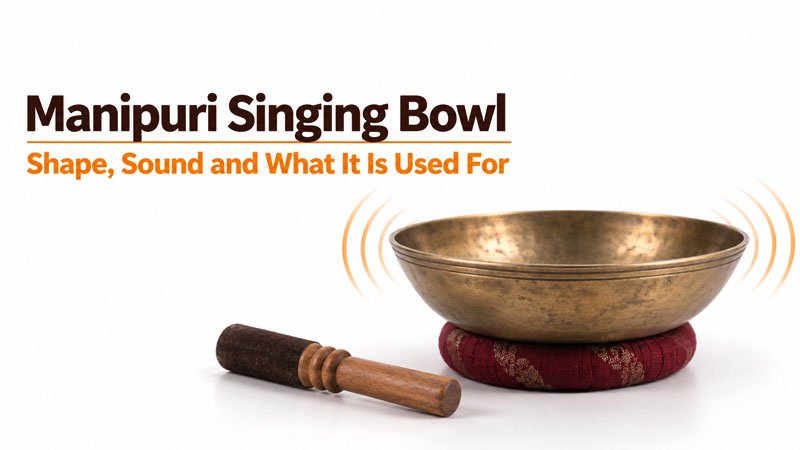
A Manipuri is the shallowest of the antique singing bowl forms: low walls, a wide rim that opens slightly outward, and a rounded base. It gives a bright, sweet tone that answers quickly, which makes it easy to play and a good fit for meditation, hand-held playing and the altar.
Key takeaways
- Know it by its depth: the lowest of the antique forms, wide and open.
- Rim opens outward: a wide mouth with a gentle flare.
- Rounded base: rest it on your fingertips or a ring cushion.
- Bright and easy: a sweet tone that answers to a light touch.
What is a Manipuri singing bowl?
Manipuri is one of the traditional antique forms, grouped by shape like the Jambati and the Thadobati. The name points to Manipur, a state in north-east India, though where these bowls were first made is not known for certain.
We do not put a date on any bowl. Age cannot be proved from patina or wear, as our guide on how to spot a fake antique singing bowl explains.
How do you recognise a Manipuri?
| Feature | What to look for |
|---|---|
| Depth | Shallow: the lowest of the antique forms |
| Rim | Wide, opening slightly outward |
| Walls | Low, and often thin |
| Base | Rounded, not flat |
| Collar | On many, a few lines cut around the outside below the rim |
| Inside | Some have faint circles at the centre, worn soft with use |
| Size | Usually small to medium; ours are 6 and 6.5 inches |
Look at it from the side. If it is wide and low, the rim opens outward and the base rolls a little on a table, you are holding a Manipuri.
How does a Manipuri sound?
- Bright: a higher voice than a deep bowl of the same width.
- Sweet: a clear, warm tone, fuller in the larger sizes.
- Quick: the sound opens fast and fades sooner than a heavy Jambati.
Every Manipuri has its own note, set by its size and wall. Find the note of yours with our free live singing bowl tuner.
How is a Manipuri different from a Jambati or a Thadobati?
| Feature | Manipuri | Jambati | Thadobati |
|---|---|---|---|
| Depth | Shallow | Deep | Medium |
| Rim | Wide, opening outward | Thick lip, sloping inward | Plain, cut straight |
| Base | Rounded | Small, flat or rounded | Flat, almost as wide as the rim |
| Sound | Bright and sweet | Deep, long sustain | Clear and focused |
| See the bowl | Manipuri | Jambati | Thadobati |
Read more in our Jambati guide and Thadobati guide, and see the raised centre of another form in what a Lingam singing bowl is.
Looking for a Manipuri?
Our old collected Manipuri bowls come in 6 and 6.5 inches. Sunita chooses yours from the collection after your order arrives.
What is a Manipuri used for?
- Short meditation: one bright strike to begin, and one to end.
- Hand-held playing: light enough to rest on your fingertips.
- The altar: its wide, open shape sits well on a shelf or altar.
- Yoga, Reiki and breathwork: a clear sound to mark each stage.
A Manipuri supports relaxation and does not treat any condition.
How do you hold and play a Manipuri?
- Rest it on your fingertips with your hand open and flat, not on the palm, where the round base turns.
- On a table, seat it in a ring cushion so it stays still.
- Strike gently on the outer wall with a wooden mallet; a light touch is enough.
- Rim with light pressure: a thin wall answers quickly, and pressing hard makes the mallet rattle.
For the basics of striking and rimming, read how to play a singing bowl in our free course.
Is a Manipuri right for you?
- Yes, if you want an antique bowl that is easy to play, light in the hand and bright in tone.
- Choose another form if you want a deep, grounding sound: a Jambati suits that better.
Compare old and new bowls in new handmade vs antique singing bowls, and small bowls of every kind in our palm size singing bowl guide.
How is your Manipuri chosen?
Our antique bowls are listed by form, not as one numbered piece. We keep a collection of old Manipuri bowls, and after your order arrives Sunita chooses one from her experience in practice.
Each one is unique in tone, patina and marks, so yours will differ a little from the photos. Dispatch is from Kathmandu in 3–4 business days by DHL Express.
Want old bowls as a set? An antique set can be put together to order through our set builder.
Frequently asked questions
What is a Manipuri singing bowl?
It is the shallowest of the antique singing bowl forms: wide and low, with a rim that opens slightly outward and a rounded base.
Why is it called a Manipuri bowl?
The name points to Manipur, a state in north-east India, though where these bowls were first made is not known for certain.
How do I recognise a Manipuri?
Look at it from the side. It is wide and low, the rim opens slightly outward, and the base is rounded, so it turns on a flat table.
What does a Manipuri sound like?
Bright and sweet, with a higher voice than a deep bowl. It answers quickly to a light strike and fades sooner than a heavy Jambati.
Why does my Manipuri spin on my palm?
Its base is rounded, not flat. Rest it on the fingertips of an open hand, or seat it in a ring cushion on a table.
Is a Manipuri good for beginners?
Yes. It is light, answers to a gentle touch and is easy to rim, so it is a good first antique bowl to learn on.
How old is a Manipuri singing bowl?
We do not put a date on any bowl, because age cannot be proved from patina or wear. Manipuri is a traditional form, and we choose each bowl for its sound.
See all our antique forms
Manipuri, Jambati, Thadobati, Lingam and more, each chosen by Sunita for its sound.