




Remuna and Goalbati Singing Bowls - Two Rare Forms Explained
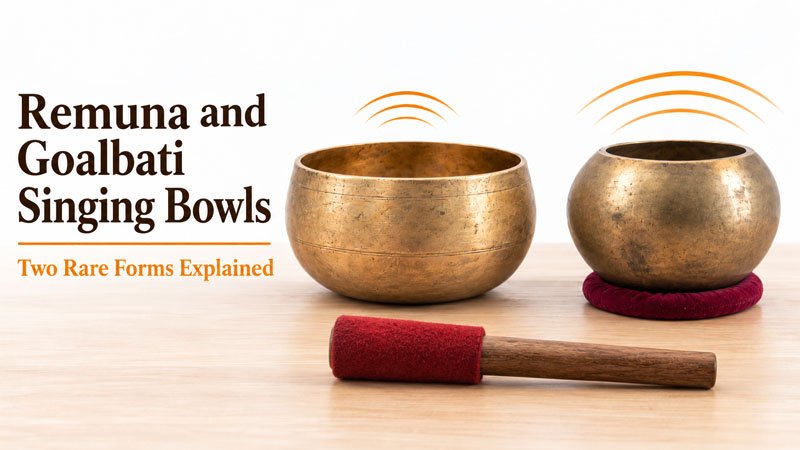
Remuna and Goalbati are two rare antique singing bowl forms, and in both the wall turns back in toward the rim. A Remuna stands on a modest flat base with a gentle belly and gives a clear, focused tone; a Goalbati is round all over, heavier, and gives a deep, warm, grounding voice.
Key takeaways
- Both are rare: they turn up far less often than Jambati or Thadobati bowls.
- Remuna: flat base, gentle belly, walls leaning in; a clear, focused tone.
- Goalbati: round all over, thick walls, rim narrower than the body; a deep, warm tone.
- Tell them apart by the base and the body: flat and gentle, or round and heavy.
What are Remuna and Goalbati singing bowls?
They are two of the traditional antique forms, grouped by shape like the Jambati, Thadobati and Manipuri. In Nepali, gol means round, which describes the Goalbati well.
We do not put a date on any bowl. Age cannot be proved from patina or wear, as our guide on how to spot a fake antique singing bowl explains.
How do you recognise a Remuna?
- Base: modest and flat, so it stands steady.
- Belly: a gentle swell, widest just below the middle.
- Walls: lean back in toward the rim, and are fairly smooth.
- Lines: often one cut around the rim and one around the belly, with circles at the centre inside.
- Sound: clear and focused, and easy to play.
Our old collected Remuna comes in 6 and 6.5 inches.
How do you recognise a Goalbati?
- Body: round all over, widest around the middle.
- Rim: clearly narrower than the body.
- Walls: thick, so the bowl feels heavy for its size.
- Base: small and rounded.
- Sound: deep, warm and steady, with a strong main note.
Our old collected Goalbati is about 6 inches across.
Remuna or Goalbati: what is the difference?
| Feature | Remuna | Goalbati |
|---|---|---|
| Base | Modest and flat | Small and rounded |
| Body | Gentle belly, low down | Round all over |
| Rim | Leans in a little | Clearly narrower than the body |
| Walls | Fairly thin and smooth | Thick and heavy |
| Sound | Clear and focused | Deep, warm and grounding |
| Good for | Focus and a clear note | Calm, slow practice and chanting |
The quickest test: set each bowl on a table. A Remuna stands flat; a Goalbati sits low on its rounded base and feels heavier in the hand.
Looking for a rare form?
We hold a few old Remuna and Goalbati bowls. Sunita chooses yours from the collection after your order arrives.
How do they compare with the other forms?
Each form has its own guide: the deep, open Jambati, the straight-walled Thadobati, the shallow Manipuri and the Lingam with its raised centre. Our guide to every type of singing bowl and types of Tibetan singing bowls bring them together.
What are they used for?
- Remuna for focus: a clear note to gather attention at the start of meditation.
- Goalbati for grounding: a deep, steady sound for slow, calm practice and chanting.
- Together: a low Goalbati with a clearer Remuna makes a natural pair, as in playing two singing bowls together.
Both support relaxation and do not treat any condition. Find the note of yours with our free live singing bowl tuner.
How do you play them?
- Remuna: strike the upper wall lightly; it answers quickly and rims easily.
- Goalbati: use a padded mallet for the deep note, and rim slowly on the outer edge of the rim.
- Seat the Goalbati in a ring cushion, because its rounded base turns on a flat surface.
For the basics of striking and rimming, read how to play a singing bowl in our free course.
How is your bowl chosen?
Our antique bowls are listed by form, not as one numbered piece. After your order arrives, Sunita chooses one from the collection from her experience in practice.
Each one is unique in tone, patina and marks, so yours will differ a little from the photos. Dispatch is from Kathmandu in 3–4 business days by DHL Express.
Want old bowls as a set? An antique set can be put together to order through our set builder.
Frequently asked questions
What is a Remuna singing bowl?
It is a rare antique form that stands on a modest flat base, with a gentle belly and walls that lean back in toward the rim. It gives a clear, focused tone.
What is a Goalbati singing bowl?
It is a rare antique form that is round all over, with thick walls, a small rounded base and a rim narrower than its body. It gives a deep, warm, grounding tone.
How do I tell a Remuna from a Goalbati?
Look at the base and the body. A Remuna stands on a flat base and swells gently below the middle; a Goalbati is round all over, sits on a small rounded base and feels heavier.
What does Goalbati mean?
Gol means round in Nepali, which describes the round body of the bowl.
Which sounds deeper, a Remuna or a Goalbati?
Usually the Goalbati. Its heavy, round body gives a deep, warm voice, while a Remuna gives a clearer, more focused note.
Are Remuna and Goalbati bowls rare?
Yes. They turn up far less often than Jambati or Thadobati bowls, and a good-sounding one is a find.
How old are Remuna and Goalbati singing bowls?
We do not put a date on any bowl, because age cannot be proved from patina or wear. Both are traditional forms, and we choose each bowl for its sound.
See all our antique forms
Jambati, Thadobati, Manipuri, Remuna, Goalbati and Lingam, each chosen by Sunita for its sound.