




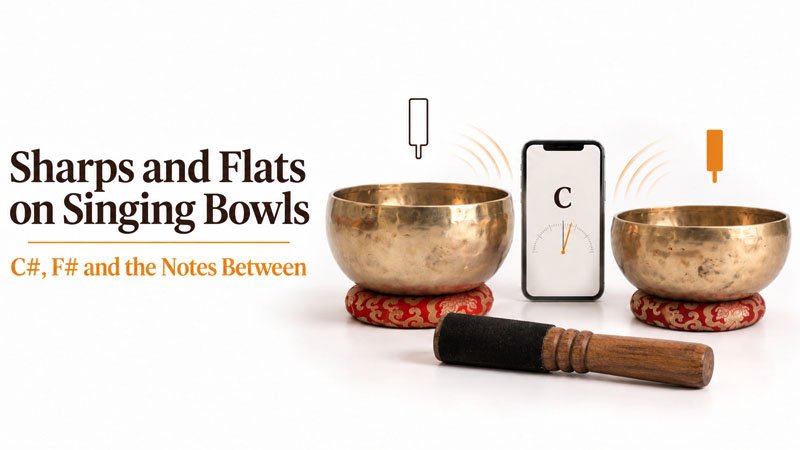
Sharps and Flats on Singing Bowls - C#, F# and the Notes Between
Yes, a singing bowl can be a sharp note such as C# or F#. A hand-hammered bowl's note is discovered, not made, and many bowls land on one of the five sharps that sit between the seven main notes.
Key takeaways
- Twelve notes: seven main notes and five sharps in one octave.
- Sharp or flat: C# and Db are one pitch with two names.
- No E# and no B#: there is no note between E and F, or B and C.
- In the twelve-note system, the sharps sit between the chakras.
What is a sharp note?
A sharp is the note just above a main note. C# sits between C and D, and F# sits between F and G.
- Five sharps: C#, D#, F#, G# and A#.
- Two names each: C# is also called Db, F# is also called Gb, and so on.
- Two gaps: E to F and B to C have no note between them, so there is no E# or B#.
The same twelve notes repeat in every octave. Our guide to singing bowl octaves explains how a low C and a high C are the same note.
Why do so many bowls land on a sharp?
Because nobody can hammer a bowl to a target note. The note is decided by the size, the shape and the wall the hammer leaves behind.
Out of twelve possible notes, five are sharps. So a good share of finished bowls land on one, and that is normal.
Most bowls also sit a little above or below the exact note. A tuner shows this as a plus or minus number in cents, which our singing bowl tuner guide explains.
Want a bowl in a sharp note?
Ask for C#, F# or any note on the custom singing bowl page. Sunita chooses your bowl after the order arrives.
Where do the sharps sit among the chakras?
In the twelve-note system I teach, the seven chakras keep their main notes, and the five sharps fall between them.
| Sharp | Also called | Sits between |
|---|---|---|
| C# | Db | Root and Sacral |
| D# | Eb | Sacral and Solar Plexus |
| F# | Gb | Heart and Throat |
| G# | Ab | Throat and Third Eye |
| A# | Bb | Third Eye and Crown |
The main notes follow the Vedic mapping. The full system is explained in the 12 chakra system, and the layout on the body in how to lay out a 12 bowl set.
What can you do with a sharp bowl?
- Play it on its own: for meditation, the note matters less than the sound you enjoy.
- Complete a twelve-note set: the five sharps fill the steps between the seven.
- Not in a seven chakra set: a seven-bowl set uses the seven main notes.
A bowl in any note supports relaxation and an attentive state. No note, sharp or not, treats a condition.
How do you find out if your bowl is a sharp?
- Open the tuner: our free live singing bowl tuner works on a phone.
- Strike softly and hold the phone near the bowl.
- Read the note: a # after the letter means a sharp.
- Read the cents: a small plus or minus is normal.
Step-by-step help is in how to find your singing bowl's note.
Which bowls should you look at?
| If you want | Look at |
|---|---|
| A bowl in a sharp note | Custom singing bowl, where you ask for the note |
| A bowl in one of the seven main notes | Note select singing bowl |
| A full twelve-note set | Set builder |
| A seven chakra set | Singing bowl sets |
What are the common mistakes?
- Thinking a sharp is a fault: it is simply where that bowl landed.
- Looking for E# or B#: these notes do not exist on a bowl tuner.
- Treating C# and Db as different: they are the same pitch.
- Adding a sharp to a seven chakra set: it belongs in a twelve-note set.
- Chasing zero cents: few hand-hammered bowls sit exactly on a note.
What should you do next?
- Study the twelve-note layout: read the course lesson on where to set all the singing bowls.
- Compare tuning standards: read 432 Hz vs 440 Hz singing bowls.
- Learn the whole method: take the free singing bowl healing course.
Frequently asked questions
Can a singing bowl be a sharp note?
Yes. A hand-hammered bowl's note is discovered when it is finished, and many bowls land on a sharp such as C# or F#. A sharp bowl is not a faulty bowl.
What is the difference between a sharp and a flat on a singing bowl?
They are two names for the same pitch. C# and Db are the same note, so a tuner may show either name for the same bowl.
Why is there no E sharp singing bowl?
Between E and F, and between B and C, there is no note in between. One octave has twelve notes: seven main notes and five sharps.
Which chakra is C sharp?
In the twelve-note system I teach, C# sits between the Root and the Sacral. The five sharps fall between the seven chakras.
Can I use a sharp bowl in a seven chakra set?
A seven chakra set uses the seven main notes. A sharp bowl suits a twelve-note set, or it can be played on its own for meditation.
Can I order a singing bowl in a sharp note?
Yes, ask for it on the custom singing bowl page. Sunita plays the bowls in your size after your order arrives and chooses one whose note is that sharp.
Why does my tuner show a sharp with a plus or minus number?
The number shows how far the bowl sits from the exact note, in cents. Few hand-hammered bowls sit exactly on a note, and a small difference is normal.
Build a twelve-note set
Tell us your size range and number of bowls, and Sunita will put the set together, sharps included.