




Singing Bowl Tuner - How to Read Hz, Note and Cents for Your Bowl
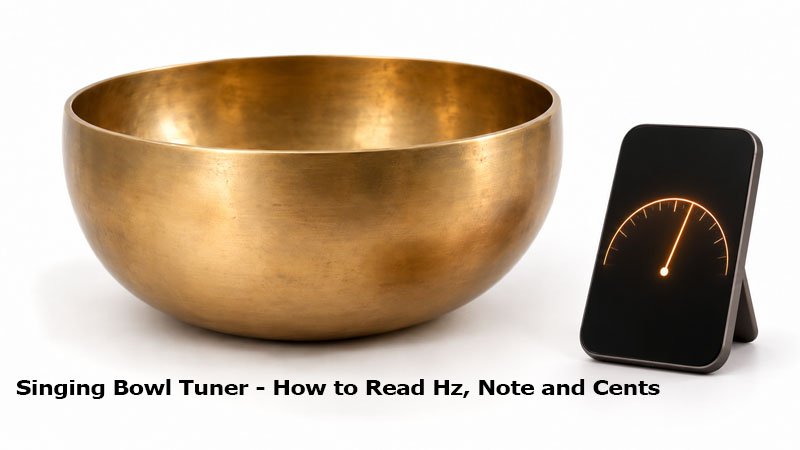
A singing bowl tuner shows three things: the frequency in Hz, the nearest note, and the cents, which is how far the bowl sits above or below that note. Read the note first, the cents second, and use the Hz when you compare one bowl with another.
Key takeaways
- Note is the name of the pitch, such as C or F.
- Hz is the exact frequency, and doubling it gives the same note one octave higher.
- Cents show the small gap between your bowl and the exact note.
- A small gap is normal, because a hand-hammered bowl's note is discovered, not made.
What is a singing bowl tuner?
It is a tool that hears your bowl through the microphone and tells you its pitch. Our free live singing bowl tuner runs in the browser, so there is nothing to install.
If you have not measured a bowl before, start with how to find the note of your singing bowl. This page explains how to read the result.
What do Hz, note and cents mean?
| Reading | What it means | Example | How to use it |
|---|---|---|---|
| Note | The name of the nearest pitch | F | Tells you where the bowl sits in a set |
| Octave number | How high or low that note is | F3 is lower than F4 | Tells a deep bowl from a bright one in the same note |
| Hz | Vibrations each second | 349 Hz | Lets you compare two bowls exactly |
| Cents | The gap from the exact note | Plus 15 cents | Tells you if the bowl sits a little high or low |
How do you read the cents?
There are 100 cents between one note and the next. So the reading can run from 50 cents below a note to 50 cents above it.
| Cents shown | What it tells you |
|---|---|
| 0 to 10, plus or minus | The bowl sits on the note |
| 10 to 30, plus or minus | Clearly that note, a little high or low |
| 30 to 50, plus or minus | The bowl sits between two notes |
Use these bands as a guide, not a rule. A hand-hammered bowl's note is discovered, not made, so a small gap is normal and is part of the bowl's voice.
Which Hz belongs to which note?
These figures use the common standard where A is 440 Hz. Most singing bowls sit in or near these two octaves.
| Note | Third octave | Fourth octave |
|---|---|---|
| C | 130.8 Hz | 261.6 Hz |
| D | 146.8 Hz | 293.7 Hz |
| E | 164.8 Hz | 329.6 Hz |
| F | 174.6 Hz | 349.2 Hz |
| G | 196.0 Hz | 392.0 Hz |
| A | 220.0 Hz | 440.0 Hz |
| B | 246.9 Hz | 493.9 Hz |
Doubling the Hz gives the same note one octave higher, and halving it gives the octave below. If you follow the other pitch standard, read 432 Hz and 440 Hz singing bowls.
Ready to read your own bowl?
Open the free tuner, strike once softly and read the note, the Hz and the cents.
Why does the reading jump around?
A hand-hammered bowl sounds several pitches at once. The first clang of a strike is the most mixed, so the tuner may show two or three notes before it settles.
- Strike softly with a padded mallet, because a hard hit brings out the high tones.
- Wait a moment and read the pitch that stays.
- Quiet the room, since a fan or a fridge can give a false reading.
- Test three times and keep the reading that comes up most often.
Is there a singing bowl tuner app?
Be careful with the word "app". Most apps sold as singing bowl apps only play recorded bowl sounds, and they do not measure the bowl in your hands.
- Sound apps: play recordings for relaxing, and tell you nothing about your own bowl.
- Guitar tuner apps: do measure pitch, but may jump because a bowl sounds several pitches at once.
- A tuner made for bowls: reads your bowl through the microphone and shows note, Hz and cents together.
Ours runs in the browser. What it does with the microphone is set out in the tuner privacy policy.
How do you check a whole set with the tuner?
- Read one bowl at a time, with the other bowls moved away so they do not ring along.
- Write a small table: bowl, note, Hz and cents.
- Lay the bowls in order from the lowest Hz to the highest.
- Check the steps: the notes should rise one by one, with no two bowls on the same note.
The full method is in how to check a chakra singing bowl set. A second way to compare pitch is shown in our post on tuning forks and singing bowl frequency.
Can a bowl be changed if the note is not the one you want?
No. A hand-hammered bowl's note is discovered after the bowl is finished, and it cannot be adjusted afterwards.
So the way to get a note is selection. After your order arrives, Sunita plays the bowls in your size and chooses one from her experience in practice.
- Choose the note on the listing: on most of our hand-hammered singing bowls the note is selectable, as on the note select singing bowl.
- Design one bowl: ask for the note on the custom singing bowl page, and add free engraving.
- Fill a gap in a set: send your tuner readings through the set builder, and the new bowls are chosen to sit with the ones you own.
What are the common mistakes when reading a tuner?
- Reading the first clang: taking the number before the sound has settled.
- Ignoring the octave: taking a deep F and a bright F as the same bowl.
- Chasing zero cents: expecting a hand-hammered bowl to sit exactly on a piano note.
- Mixing standards: comparing a 432 chart with a 440 reading.
- Testing bowls together: leaving other bowls close by, where they ring along and blur the result.
What should you learn next?
Our course lesson on singing bowl notes and frequencies explains what the notes are used for. It is part of the free singing bowl healing course.
Frequently asked questions
How do I use a singing bowl tuner?
Open the tuner, allow the microphone, strike the bowl softly and wait for the reading to settle. Then read the note first, the cents second and the Hz last.
What does Hz mean on a singing bowl tuner?
Hz is the frequency, the number of vibrations each second. A higher number means a higher sound, and doubling the number gives the same note one octave up.
What do cents mean on a singing bowl tuner?
Cents show how far the bowl sits above or below the exact note. There are 100 cents between one note and the next, so plus 20 cents means slightly high.
Is there a singing bowl tuner app?
Most apps sold as singing bowl apps only play recorded bowl sounds and do not measure your bowl. Our live singing bowl tuner runs in the browser and reads your own bowl through the microphone.
Why does the tuner reading keep changing?
A hand-hammered bowl sounds several pitches at once, and the first clang of a strike is the most mixed. Strike softly, wait a moment and read the pitch that stays.
Can the note of a singing bowl be changed if it is wrong?
No. A hand-hammered bowl's note is discovered after the bowl is finished and cannot be adjusted afterwards. A bowl in the note you want is found by selection.
How do I check a whole set of singing bowls with a tuner?
Read each bowl one at a time and write down the note, Hz and cents. Then lay the bowls in order and check that the notes rise step by step without two bowls sharing one note.
Looking for a bowl in a certain note?
See our hand-hammered singing bowls, where size, finish and note are selectable on most bowls. A mallet and cushion come with every bowl.