




How to Check if a Chakra Singing Bowl Set Is Really in Tune
Short answer: check two things — each bowl's note, and how the bowls sound together. A tuner tells you the first. Only your ears tell you the second, and it is the one that decides whether you have a set or just seven bowls.
The quick check, in four steps:
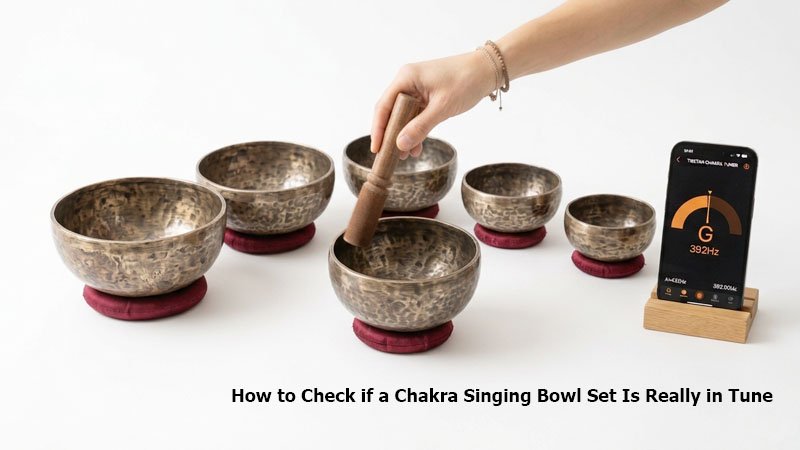
- Measure each bowl with a free online tuner such as our live singing bowl tuner. You should see C, D, E, F, G, A and B in order.
- Check the Root is the largest bowl and the Crown the smallest.
- Play neighbouring pairs together and listen for a fast "wah-wah" beating.
- Compare sustain — strike each bowl the same way and note which one dies away early.
One thing to understand first: a hand-hammered bowl's note is discovered, not made. No bowl reads perfectly on a tuner, and a set is tuned by choosing bowls whose notes sit together — not by hammering each one to a target.
What "in tune" actually means for a singing bowl
A singing bowl is not a piano. A smith working by hand produces a bowl, and the bowl turns out to have a pitch — a consequence of its diameter, wall thickness, profile, alloy and thousands of hammer strikes. Nobody controls all of those precisely enough to hit a chosen note, which is why we say the note is discovered rather than made. Our post on why every singing bowl sounds different explains the hammering side of this.
So "in tune" means two different things depending on what you are checking:
- A single bowl is "in tune" if its fundamental — the lowest, strongest tone — sits close to the note it is sold as. Close, not exact.
- A chakra set is in tune if its seven bowls sit correctly against each other: the right order, sensible intervals, overtones that agree and sustain that matches. A set where every bowl is individually close but the bowls clash together is not in tune.
That second meaning is why a genuine chakra set is tuned by a sound healer rather than labelled by a machine. The tuning happens across the set, by selection, and a tuner alone cannot hear it.
How to check a singing bowl's note with a tuner
You do not need special equipment. Any phone or laptop with a microphone will do, and our free singing bowl frequency analyser runs in your browser with nothing to install — it listens through your microphone and shows the note and its frequency in hertz.
Step 1 Set up a quiet test
Choose a quiet room, place the bowl on its cushion or ring so it rings freely, and hold the phone about 30 centimetres away. Background noise — a fan, traffic, a fridge — confuses any tuner.
Step 2 Check the reference pitch
Most tuners assume the standard reference where A = 440 Hz. If a set is sold as 432 Hz, set the tuner to A = 432 first, or every bowl will look about 32 cents flat. Our guide to 432 Hz versus 440 Hz bowls explains the difference.
Step 3 Rim the bowl, then strike it gently
Rimming with a wooden mallet tends to bring out the fundamental clearly. A gentle strike with a soft mallet works too, but a hard strike produces a burst of overtones and the tuner may lock onto one of those instead. Our mallet guide covers which mallet does what.
Step 4 Read the note, the octave and the cents
The tuner shows a note name with an octave number — F4, C3 — the frequency in hertz, and how many cents sharp or flat the bowl is. One hundred cents make a semitone. Write down the reading for each bowl.
Step 5 Repeat for every bowl
You should end up with C, D, E, F, G, A and B, running from the largest bowl to the smallest. The octave numbers do not need to match — a set can span octaves — but the notes should rise in order as the bowls get smaller.
Check your bowls now — free
Our live singing bowl tuner runs in your browser and shows the note and frequency of any bowl in seconds. Test a set you own, or one you are thinking of buying, before you decide.
What frequency should each chakra bowl be?
These are the standard frequencies for each note at both common reference pitches, in the third and fourth octaves where most chakra bowls sit. A bowl one octave lower reads exactly half the frequency; one octave higher reads double.
| Chakra | Note | A = 440 Hz (octave 3 / 4) | A = 432 Hz (octave 3 / 4) |
|---|---|---|---|
| Root | C | 130.81 / 261.63 Hz | 128.43 / 256.87 Hz |
| Sacral | D | 146.83 / 293.66 Hz | 144.16 / 288.33 Hz |
| Solar Plexus | E | 164.81 / 329.63 Hz | 161.82 / 323.63 Hz |
| Heart | F | 174.61 / 349.23 Hz | 171.44 / 342.88 Hz |
| Throat | G | 196.00 / 392.00 Hz | 192.43 / 384.87 Hz |
| Third Eye | A | 220.00 / 440.00 Hz | 216.00 / 432.00 Hz |
| Crown | B | 246.94 / 493.88 Hz | 242.45 / 484.90 Hz |
Do not expect a hand-hammered bowl to land on these numbers exactly. As a working rule of thumb, a bowl within about 25 cents of its note is generally accepted as that note; closer is better, and a bowl a full semitone out is simply a different note. Our post on tuning forks and singing bowl frequency goes deeper into pitch.
Why your tuner may show different notes for the same bowl
This is the most common reason people think a bowl is faulty when it is not. A hand-hammered bowl produces a fundamental wrapped in several overtones, and a tuner reports whichever one is loudest at that moment.
- It jumps to a higher note when you strike. A strike excites the upper partials. Rim the bowl instead and the reading usually settles on the fundamental.
- It reads an octave higher or lower. Same note, different octave. That is fine.
- The reading drifts as the bowl fades. Take the reading in the first few seconds while the tone is strong and steady.
- Two notes alternate. Hand-hammered bowls often have a slightly split fundamental — two close tones that create a gentle pulse. A little is part of the character; a lot is worth asking about. See is my singing bowl faulty?
The tests a tuner cannot do
Correct notes are only half of a tuned set. These checks need your ears, and they are what separate a set that was tuned from one that was assembled from stock with chakra labels attached.
The beating test
Strike two neighbouring bowls — Root and Sacral, then Sacral and Solar Plexus, and so on up the set — and let them ring together. Listen for a fast, regular "wah-wah" pulse. That is beating: two of the bowls' partials sit almost, but not quite, together. A little is natural in hand-hammered bowls. Strong, fast beating between neighbours means the bowls were never chosen to work together.
The sustain test
Strike each bowl with the same mallet and the same force, and count how long it rings until silence. In a well-chosen set the bowls fade at broadly similar rates, scaled for size. One bowl that dies away far sooner than the rest will drop out of every sequence you play.
The rim response test
Rim each bowl with the same pressure and speed. Every bowl should begin to sing without you having to change your technique. If one needs much more pressure, rattles, or refuses to sing, it will fight you in every session.
The Root test
The Root bowl carries the whole set. It should be the largest bowl, with a full, grounded tone and a long sustain. A thin, short Root is the most common flaw in mass-assembled sets — and it weakens everything above it.
The sequence test
Play the set from Root to Crown as you would in a session — our guide on how to use a 7 chakra singing bowl set gives the full sequence. A tuned set rises smoothly. An assembled one sounds uneven: one bowl too bright, one too dull, one jumping out of the line.
Quick checklist: tuned set or assembled set?
| Check | How | Tuned set | Warning sign |
|---|---|---|---|
| Notes | Tuner, each bowl | C to B in order, each within about 25 cents | A bowl a semitone or more off its label |
| Size order | Line them up | Root largest, Crown smallest | Similar sizes with different labels |
| Beating | Neighbouring pairs together | Smooth or a gentle slow pulse | Fast, harsh "wah-wah" between neighbours |
| Sustain | Same strike, count to silence | Even across the set | One bowl fading far sooner |
| Rim response | Same pressure on each | Every bowl sings easily | One rattles or will not sing |
| Root | Strike and listen | Full, grounded, long | Thin and short |
| Proof | Ask the seller | A recording of your actual set | Only stock sound clips |
Can you retune a singing bowl?
Not in any practical sense at home. Pitch can be nudged slightly by removing metal, but that is a skilled workshop job and it can easily damage a bowl. A bowl does not drift out of tune the way a guitar string does — barring a crack or a dent, its note stays the same for life.
So if one bowl in a set does not fit, the answer is not to change that bowl. It is to replace it with one that does:
- Replace a single note. Our Tibetan singing bowl collection has individual hand-hammered bowls across the notes.
- Have a bowl made to your choice. A custom singing bowl lets you choose the note, diameter, finish and design, with personal engraving included free — and the bowl is played and judged after it is finished.
- Match bowls to a set you already own. Send us your readings through the custom set builder, and new bowls are selected to sit with the ones you have.
How our sets are checked before they ship
Every chakra set we sell is tuned by selection. Sunita plays bowls from the workshop and keeps only the seven whose notes sit correctly together — interval accuracy, overtones that agree, even sustain, consistent rim response and a grounded Root. The decoration is finished before any bowl is judged, so the note you are given is the note of the finished bowl. Bowls that will not come into line are left out and sold individually.
And because the only honest proof is the actual instrument, we will record your set — each bowl alone, then in sequence — and send you the video before it ships. If you would rather check it yourself when it arrives, use the tuner and the tests above; our 30-day satisfaction guarantee covers you either way.
Build a set that is tuned as a set
Choose a ready chakra set, or specify your own — the notes, the number of bowls, the sizes and the finish — and Sunita selects bowls that sit together, then plays the full set before it ships. Learning to use it? Our free singing bowl healing course is open to everyone.
Frequently asked questions
How can I tell if my singing bowl is in tune?
Measure it with a tuner, rimming the bowl so the reading settles on the fundamental. If the note is within about 25 cents of the note it was sold as, it is generally accepted as that note. For a set, also play neighbouring bowls together and listen for harsh beating.
Can I use a tuner app on a singing bowl?
Yes. Any chromatic tuner works, as long as you test in a quiet room and rim the bowl or strike it gently. Our free live singing bowl tuner runs in your browser and shows the note and frequency.
Why does my tuner show different notes for the same bowl?
A singing bowl produces a fundamental plus several overtones, and a tuner reports whichever is loudest. A hard strike brings out the upper partials. Rim the bowl and read in the first few seconds, while the tone is strong.
What frequency should a Root chakra bowl be?
A Root bowl is a C. At the standard A = 440 Hz reference, C is 130.81 Hz in the third octave and 261.63 Hz in the fourth. At A = 432 Hz it is 128.43 Hz and 256.87 Hz.
Do singing bowls go out of tune?
No, not in the way string instruments do. A bowl's note stays the same for life unless it is cracked or badly dented.
Can a singing bowl be retuned?
Only slightly, by removing metal in a workshop, and it risks damaging the bowl. If a bowl does not fit a set, the better answer is a replacement bowl selected to sit with the others.
How do I know if a chakra set is real or just labelled?
Check that the notes run C to B in order with the Root as the largest bowl, that neighbouring bowls do not beat harshly together, and that sustain is even across the set. Ask the seller for a recording of your actual set rather than a stock sound clip.