



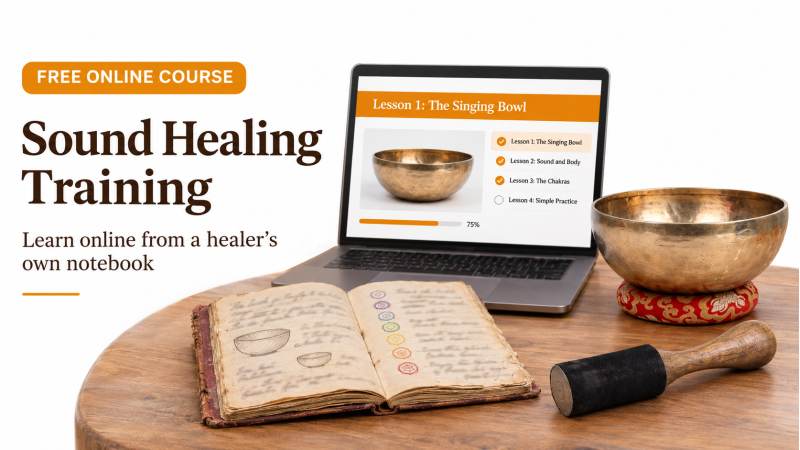
Sound Healing Training - How to Choose a Course, Online or In Person, and What Certification Means
Good sound healing training teaches you to play the instruments well, keep people safe and run a complete session, with supervised practice before you work with clients. The easiest place to start is online, with a free course such as ours, designed from Sunita's own healing notebook, then add in-person or retreat training for hands-on feedback. Sound healing is not a regulated profession, so a certificate shows what you studied rather than a licence, and the practice supports relaxation and focus, and does not treat any condition.
Key takeaways
- Start online: learn free with our Singing Bowl Healing Course, designed from Sunita's own healing notebook.
- Add hands-on practice: in-person or retreat training gives you feedback on real people.
- Certificates vary: no government body licenses sound healers, so check what a certificate stands for.
- Watch for red flags: medical promises, no practice hours, or "accreditation" you cannot check.
What should good sound healing training cover?
Whatever the format, a good course teaches more than how to make a bowl ring. Look for these six things:
- Playing technique: striking, rimming and getting a clean, steady tone from a bowl.
- Instruments: how bowls, gongs, tingsha and bells are used, and when each one fits.
- Safety: client intake and the contraindications, such as pregnancy, pacemakers and epilepsy.
- Session structure: how to open, build, close and bring someone gently back.
- Scope and ethics: what you can honestly say about sound healing, and when to refer someone to a doctor.
- Supervised practice: playing for other people while a teacher watches and gives feedback.
Online, in person or retreat: which is right for you?
Each format has a different job. This is how they compare:
| Format | Best for | Strengths | Limits |
|---|---|---|---|
| Online, at your own pace | Beginners, busy people and anyone testing the waters | Learn anywhere, any time, and often free or low cost | No teacher hears you play, so feedback is limited |
| Live online classes | People who want a teacher but cannot travel | Real-time questions and some feedback | Touch and bowl placement are hard to judge on a screen |
| In-person course | People planning to work with clients | Hands-on feedback and practice on real people | Fixed dates, travel and a bigger commitment |
| Retreat training | People who want deep immersion | Daily practice in a calm setting, often in Nepal, Bali or Thailand | Short and intense, so you still need practice at home afterwards |
For most people the best path is both: start online to learn the foundations, then add in-person practice once you know you want to work with others. That way you arrive at a paid course already able to play.
Start online: our free course, designed from Sunita's own notebook
Our Singing Bowl Healing Course is designed from Sunita's own notebook: the handwritten notes she kept during her sound healing training in Kathmandu and then used in her own sessions. It is a healer's working method, not a course written from scratch for the internet.
We turned her notebook into clear online lessons, adding explanation only where her notes assumed you already knew something. You can read every lesson free on our website, with no account, email or payment needed.
The lessons are arranged as four courses that build on each other:
| Course | What you learn |
|---|---|
| 1. Foundation | Holding, striking and rimming a bowl, the seven notes, an overview of the chakras, preparing to practise and your first self-session |
| 2. The Seven Chakras | One lesson for each chakra, the petals, mantra and voice, and a complete seven-bowl self-healing |
| 3. Healing Methods | Client intake and contraindications, the Vedic and Tibetan healing sessions, sound massage, and closing and waking a session |
| 4. Twelve Chakras | Bowl placement for all twelve chakras, the one-hour session, brainwave states, and Reiki and sound together |
Each course ends with a ten-question quiz, and a wrong answer simply points you back to the lesson so you can try again. When you pass, you can request an optional certificate of completion with your name, emailed to you within two working days.
The course is honest about its limits. Its certificates are certificates of completion, not a licence to practise, and Courses Three and Four teach working on other people, where supervised practice with a teacher is what makes a practitioner.
Start learning sound healing today, free
Four online courses designed from Sunita's own healing notebook, from your first strike to a full healing session, at your own pace.
You can read the story of Sunita's notebook, and why we made the course free, in our free singing bowl healing course.
What does sound healing certification really mean?
Unlike music therapy, sound healing is not a regulated profession in Australia, the UK or the US. There is no government licence, and no single body sets one standard for every course.
Music therapy is different. Australia has Registered Music Therapists (Australian Music Therapy Association), the UK protects the title of music therapist through the Health and Care Professions Council, and the US has board-certified music therapists (CBMT), all with university-level training and clinical placements.
So a sound healing certificate tells you who taught you and what you studied. Some schools are recognised by private associations or accepted by insurers, which matters if you plan to see paying clients.
Questions to ask before you choose a course
- Who teaches it, and where did they train?
- How many practice hours are included, and is any of it supervised?
- Does it cover safety, client intake and contraindications?
- What does the certificate say, and who recognises it?
- Will your insurer accept it if you plan to work with clients?
- Can you see the content first, or try a lesson before you pay?
A good school will answer all six clearly. With our free course you can read every lesson before you decide anything.
Red flags to watch for
- Medical promises: any course that says sound healing can fix a disease or replace medical care.
- Accreditation you cannot check: the name of a body you cannot find or verify.
- No practice: a certificate with no playing, practice or feedback.
- Pressure to buy: an expensive instrument package required before the first lesson.
- Instant master titles: grand titles after a single weekend.
Do you need instruments before you start?
One good bowl is enough to begin. The Foundation course is written for a single bowl, and our hand-hammered singing bowls are a good first choice for practice.
Later lessons, such as the complete seven-bowl self-healing, use a set. When you reach them, our chakra singing bowl sets come in sets of 3, 5, 7, 9 and 12, and Sunita plays and selects every bowl for each order before it leaves Kathmandu.
What comes after training?
Practise on friends and family who agree to it, keep simple notes after each session, and find a teacher or mentor who can watch you play. Before you charge for sessions, arrange insurance and check what your venue asks for.
Our guide to a singing bowl healing career covers costs, income and where healers work. If you want to learn in the Himalayas, see singing bowl healing training in Nepal, and for your first year, our beginner sound healer guide.
| If you want | Look at |
|---|---|
| To start learning today | Free Singing Bowl Healing Course |
| A first bowl for your training | Hand-hammered singing bowls |
| A set for the chakra lessons | Chakra singing bowl sets |
| Any singing bowl | Tibetan singing bowls |
Frequently asked questions
How do I become a certified sound healer?
Choose a course with clear content, supervised practice and a certificate that says what you studied. Many people start with a free online course to learn the foundations, then add in-person training before working with clients.
Is sound healing certification recognised?
Sound healing is not a regulated profession in Australia, the UK or the US, so no government body recognises one certificate over another. Some schools are recognised by private associations or accepted by insurers, so check this if you plan to see paying clients.
Can I learn sound healing online?
Yes. Online courses are a good way to learn the foundations at your own pace. For working with other people, add some in-person or supervised practice so a teacher can give you feedback.
Is there a free sound healing course?
Yes. Our online Singing Bowl Healing Course, designed from Sunita's own healing notebook, is free to read with no account needed. Each of its four courses ends with a quiz and an optional certificate of completion.
How long does sound healing training take?
It ranges from weekend workshops to programmes that run over several months. The number of supervised practice hours matters more than the length of the course.
Do I need a certificate to offer sound baths?
There is no government licence for sound healing in Australia, the UK or the US. Insurers and venues often ask for proof of training, so a certificate from a course you can describe clearly is still useful.
What is the difference between sound healing training and music therapy training?
Music therapy is a regulated or credentialed health profession with university training and clinical placements. Sound healing training prepares you for relaxation-focused wellness work, not clinical care.
Does sound healing really work?
Many people find it deeply relaxing, and early research is encouraging but small. Sound healing supports relaxation and focus, and does not treat any condition.
Your sound healing training can start today
Learn from Sunita's own healing notebook: read every lesson free, take the quizzes as often as you like, and request a certificate of completion for each course.