



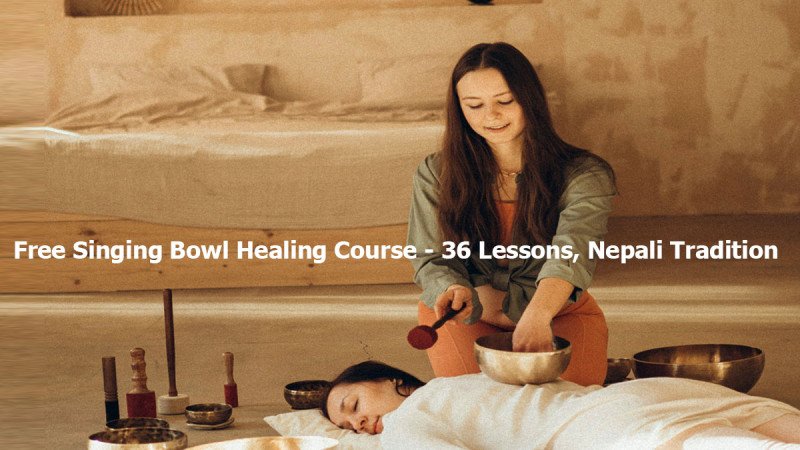
Thirty-six lessons, four courses, and nothing to pay
This is a complete singing bowl healing course, and it costs nothing. Thirty-six lessons across four courses, transcribed from the handwritten training notebook of Nepali sound healer Sunita Poudel. No account, no email, nothing locked.
Most sound healing courses cost between two hundred and a thousand dollars. This one is free to read in full, and this post explains what is in it, where it came from, and why we are not charging for it.
Start with Course One. Eight lessons, about two hours of reading, ending with a complete session you give yourself.
Where did this course come from?
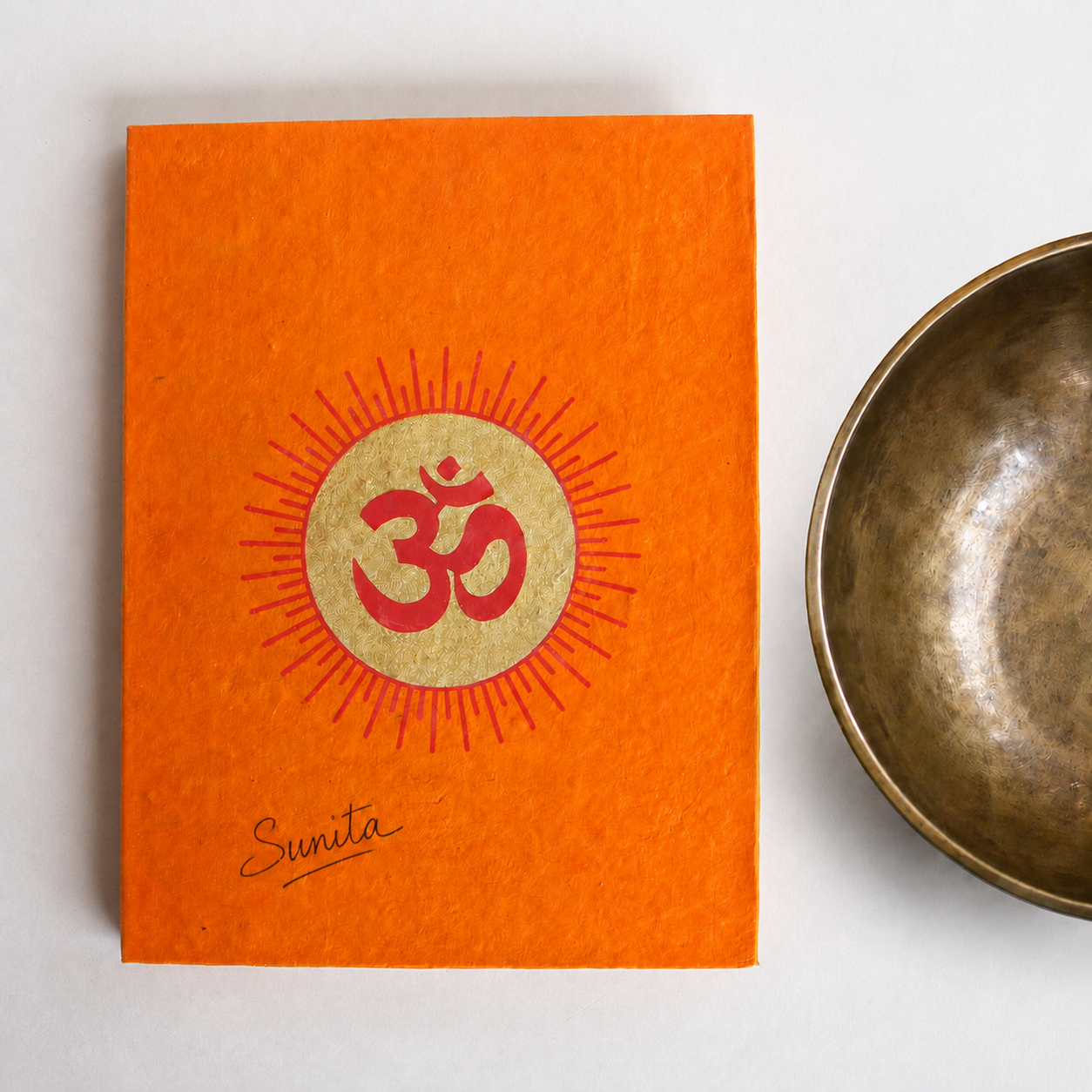
Sunita Poudel trained in sound healing in Kathmandu, and like most students in that tradition she kept a notebook — written by hand, on lokta paper, during her own training and used afterwards in her own sessions.
It is not a textbook. It is working notes: bowl placements, timings, note sequences, which hand a client should move first depending on the time of day, sketches of chakras with their qualities written around the petals. Some pages are in English, some in Nepali, some in both.
We photographed it, transcribed it, and turned it into thirty-six lessons.
What makes this different from other singing bowl courses?
Most singing bowl content online covers the seven chakras and their colours, then stops. It largely repeats itself because it comes from the same handful of sources.
Sunita's notebook contains material those sources do not have.
Vedic and Tibetan sound healing are two separate systems. They assign different notes to the same chakras. In the Vedic system the root chakra is C; in the Tibetan system the root is F. Only the crown agrees between them, and the two are never mixed within a session. We could not find that comparison written down anywhere else in English — it is in Lesson 3.1.
Root to crown is therapy. Crown to root is healing. Two lines in the notebook that decide the shape of every session — Lesson 1.6.
Warm water therapy, a method for elderly clients who cannot get down onto a mat. Almost every other sound healing method assumes a body that can lie flat for forty minutes.
An eighteen-day treatment programme — sound massage, warm water therapy and rest, repeated across three cycles, giving twelve sessions and six rest days.
Panchatatva, the cleansing of the five elements, and the twelve chakra system with its correspondence to the endocrine glands.
What do the four courses cover?
Course One — Foundation. Eight lessons: what a Himalayan singing bowl is, how to hold, strike and rim it, the seven notes and their frequencies from C at 131 Hz to B at 250 Hz, and a complete ten-minute self-session. Worth starting here even if you have owned a bowl for years, because the commonest problem — a bowl that will not sing — is almost always the hand rather than the bowl.
Course Two — The Seven Chakras. Eleven lessons, one per chakra, covering location, day, note and frequency, mantra, element, mudra, metal, ruling planet and affirmation. It ends with a full seven-bowl healing session.
Course Three — Healing Methods. Nine lessons on working with other people: both healing systems, client intake and contraindications, sound massage, warm water therapy, five-element cleansing, and the eighteen-day programme.
Course Four — The Twelve Chakra System. Eight advanced lessons: the twelve-bowl layout, endocrine correspondences, the one-hour combined session, brainwave states and entrainment, and Reiki alongside the bowls.
Why is the course free?
Three reasons, and one of them is commercial.
Because it was not ours to sell. This tradition was taught to Sunita by her teacher, who was taught by theirs. Putting a paywall in front of it felt wrong in a way we could not argue ourselves out of.
Because we sell bowls. That is the commercial part, and we would rather say it than pretend otherwise. Someone who learns to use a bowl properly is more likely to want a good one. That seems a fair exchange, and it does not require charging for the lessons.
Because a locked course is a course nobody reads. We would rather ten thousand people stop struggling with their bowls than two hundred people pay for the privilege.
Does sound healing treat illness?
No. Sound work is genuinely useful for relaxation, stress, sleep and settling a busy mind. It is not a treatment for disease, and the course says so throughout.
There is a full lesson on who should not receive sound healing — pregnancy, pacemakers, epilepsy, recent surgery and more. There is another explaining that sound healing does not boost the immune system, because it does not, whatever the rest of the industry says.
We have also been straight about the seven-metals story: most singing bowls are bronze, and the additional metals are usually trace impurities rather than a sacred recipe.
How many singing bowls do you need for the course?
One. Course One is designed around owning exactly one bowl, and Course Two can be worked through with a single bowl and your attention.
If you are choosing your first, Lesson 1.4 explains why an A or B bowl is the most forgiving purchase — those two are the universal bowls, playable for any person and any chakra. Most people start with the handmade bowls, and our guide to choosing a singing bowl covers size, wall thickness and note. If you already own one and do not know what it is, the frequency analyser will identify it in seconds.
Beyond that, the lessons point where they point:
- Courses Two and Three assume a seven-bowl chakra set — a graded series from large to small, never seven matching bowls.
- The root bowl at 131 Hz needs mass, which is why root bowls sit among the large standing bowls.
- Every session opens and closes with tingsha, and begins with incense.
- Sound massage and warm water therapy want a heavier bowl and a ring cushion.
- If you are working on something specific, bowls are grouped by what people come to them for — sleep, stress and anxiety, and meditation.
Or browse the full range of Tibetan singing bowls if you already know what you are after.
Can you have a singing bowl made for you?
Yes, and it is the route we would take ourselves.
Rather than choosing from what happens to be in stock, you can have a bowl made to your own specification, so the first bowl you learn on already belongs to your practice rather than to a shelf.
- Chakra and note — choose the note you want to work with, whether a universal A or B for everything, or the specific chakra you have decided to give your next month to.
- Size — larger for a lower note and longer sustain, smaller for work near the head and for travelling.
- Finish — plain hammered, antique, carved or etched.
- Personalisation — a name, a date or a mantra engraved into the bowl.
- Blessed by monks — if you would like it blessed before it is sent.
It takes longer than adding something to a basket. That is rather the point.
Begin with a bowl of your own. Choose the note, size, finish and engraving, and we will have it made in Nepal.
Is there a certificate?
Each course ends with ten questions. Answer all ten correctly and the page shows a completion code — that part is free, and it is where most people stop.
If you would like a certificate, each course has one, priced from $10 to $30. They record that you studied the material. They are not a licence to practise, and the course says so: supervised practice with a teacher is what makes a practitioner, and no website can replace it.
We do not only sell bowls
Anyone can ship a piece of bronze. What is harder, and what took considerably longer, is being able to tell you what to do with it once it arrives.
That is why the course is free, why the frequency analyser and the chakra quiz are free, why the 30-day routine calendar is free, and why the full chakra and note reference sits on the site rather than behind an email form.
We sell bowls. We also know what they are for, and we would rather share that than hold onto it.
Thirty-six lessons. Four courses. No signup, no email, nothing locked.