



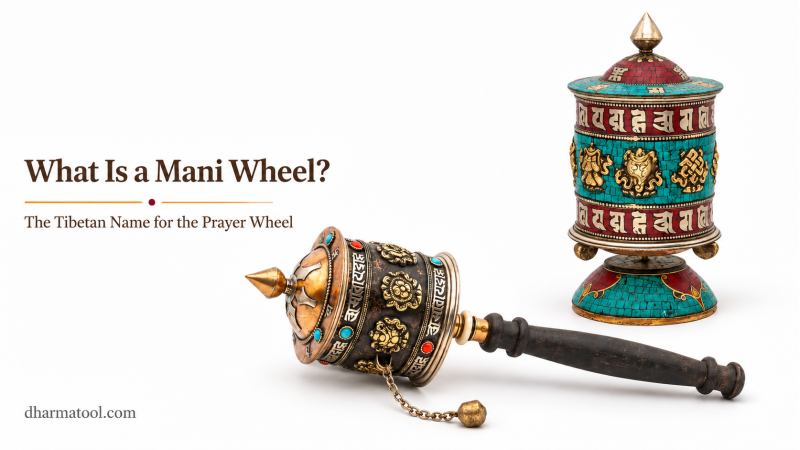
What Is a Mani Wheel? The Tibetan Name for the Prayer Wheel
A mani wheel is the Tibetan name for a prayer wheel: a cylinder filled with the mantra Om Mani Padme Hum that you turn clockwise as a form of prayer. The full Tibetan name is mani chökhor, and "mani" means jewel, from the Sanskrit cintamani. Mani wheel and prayer wheel are the same object, one name from Tibet and one from English.
Mani wheels come hand-held, table-top, wall-hanging and as large fixed wheels in monasteries. Turning one is a quiet practice of mantra and intention: it supports relaxation and focus, and does not treat any condition.
Key takeaways
- Same object, two names: mani wheel is the Tibetan name, prayer wheel the English one.
- Mani means jewel, from the Sanskrit cintamani, and points to the mantra Om Mani Padme Hum.
- Mani lagkhor is the hand-held wheel; table-top, wall-hanging and monastery wheels share the mani name.
- Keep it raised and within reach, where you pass it every day, and turn it clockwise.
Why is it called a mani wheel?
The full Tibetan name is mani chökhor, written mani chos 'khor (Tibetan Buddhist Encyclopedia). Mani means jewel, from the Sanskrit cintamani, the wish-fulfilling jewel; chö means Dharma; and khor or khorlo means wheel.
So a mani wheel is, word for word, a jewel Dharma wheel. The jewel is also the heart of the mantra inside it, Om Mani Padme Hum, often translated as "the jewel in the lotus".
The mantra itself is often called simply "the mani", which is also why stones and walls carved with it are known as mani stones and mani walls. Our guide to what mantra is written on a prayer wheel shows the script, the lines and the scroll inside.
Mani wheel or prayer wheel: is there a difference?
No. They are two names for the same object: English speakers say prayer wheel, Tibetans say mani or khorlo, and shops use both. Wikipedia notes that "mantra mill" may even be a closer translation than prayer wheel, because what turns inside is a mantra (Wikipedia).
| Name | Language | What it means |
|---|---|---|
| Mani wheel | English, from Tibetan | A prayer wheel holding the mani mantra, also called a mani prayer wheel |
| Mani chökhor (mani chos 'khor) | Tibetan | Jewel Dharma wheel, the full name |
| Khorlo ('khor lo) | Tibetan | Wheel |
| Mani lagkhor (lag 'khor) | Tibetan | Hand wheel: the hand-held prayer wheel |
| Thardo khorlo | Tibetan | An electric prayer wheel that turns without stopping |
| Prayer wheel | English | The usual English name for the same object |
| Dharma wheel (dharmachakra) | Sanskrit | A different thing: the eight-spoked symbol of the Buddha's teaching |
The last name causes the most confusion. A dharmachakra is a symbol, not a wheel you turn, as our dharma chakra vs prayer wheel guide explains.
The kinds of mani wheel
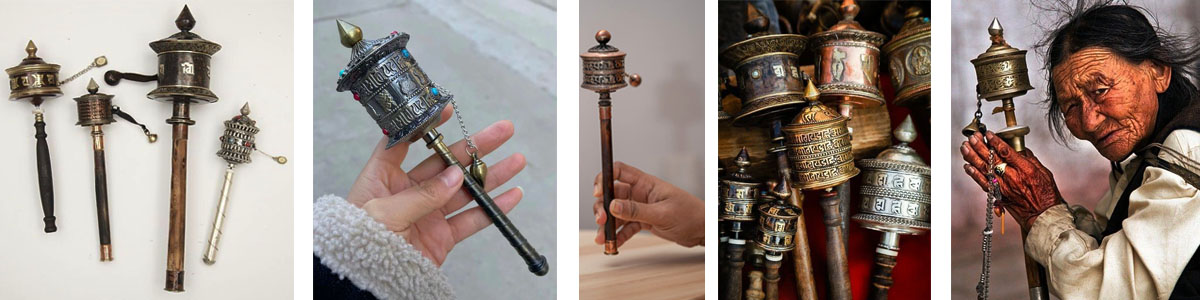
- Hand-held (mani lagkhor): a drum on a handle, turned as you walk, sit or recite, with a small weight on a chain that keeps it spinning.
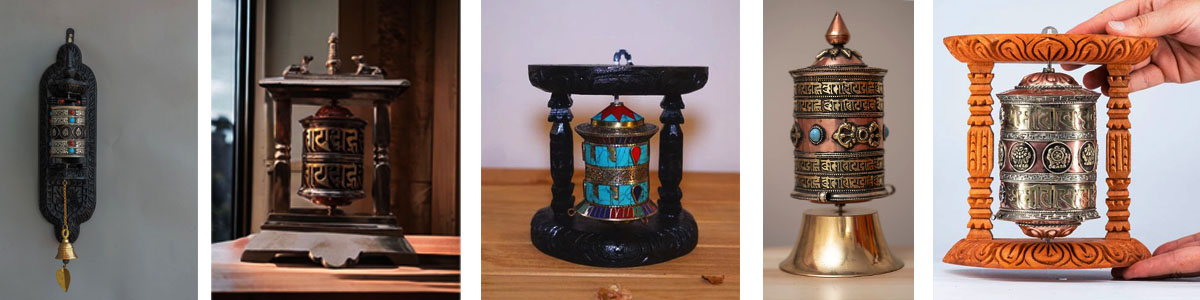
- Table-top: a drum on a base for your shrine or desk, turned with a light touch of the fingers.
- Wall-hanging: a drum in a frame on a wall or beside a door, turned as you pass.
- Large fixed wheels: set in rows along monastery walls, or alone in their own temple room, turned by pilgrims as they walk clockwise.
- Water, wind and fire wheels: turned by a stream, by the wind, or by the heat of a candle or lamp.
- Electric (thardo khorlo): turned by a small motor, day and night.
Our prayer wheel types guide compares hand-held, table-top and wall-hanging wheels in detail, and automatic vs handmade prayer wheels covers the electric kind.
How do you turn a mani wheel?
Turn it clockwise and steadily, with the mantra on your lips or simply in mind. Tradition holds that each turn counts like reciting the mantras inside (Britannica).
Our guides on which direction to turn a prayer wheel and prayer wheel meaning and daily practice go deeper.
Where to place a mani wheel at home
The simple rule is to keep it raised, clean and within reach, somewhere you pass every day. A wheel you see and touch often is a wheel you turn.
| Wheel | Where to keep it | Tip |
|---|---|---|
| Hand-held | Upright in a stand on your shrine, or on a clean shelf | A stand is an optional extra on our hand-held wheels |
| Table-top | On your shrine, altar or desk | Keep it within easy reach, so you give it a turn as you sit down |
| Wall-hanging | At hand height by a doorway or in a hallway | Turn it each time you walk past, as people do at monastery entrances |
Wherever it goes, keep it off the floor and out of the bathroom, and dust it as you would any shrine object.
Choosing your mani wheel
Every Tibetan mani wheel in our Tibetan prayer wheels range is handmade in Nepal, decorated with the mantra, the eight auspicious symbols or stone inlay. For walking practice, an 8 inch hand-held mantra prayer wheel is easy to carry and turn.
For a shrine, a 6 inch table-top wheel with the four-line mantra fits a small space, and an 8 inch wall-hanging Om Mani Padme Hum wheel suits an entrance. Browse all hand-held prayer wheels or table-top and wall-hanging prayer wheels.
A mani wheel and a singing bowl
A singing bowl sits well beside a mani wheel on a shrine: strike it once, then turn the wheel with the mantra. Our carved and etched singing bowls carry Om Mani Padme Hum in Tibetan script, and a custom singing bowl can be engraved with the mantra free of charge.
If you want to bring sound into your daily practice, our free singing bowl healing course, designed from Sunita's own notebook, is a good next step.
Find your mani wheel
Handmade prayer wheels from Nepal, packed with care and dispatched from Kathmandu within 3 to 4 business days by DHL Express.
| If you want | Look at |
|---|---|
| A wheel to carry and turn as you walk | Hand-held prayer wheels |
| A wheel for your shrine or wall | Table-top and wall-hanging prayer wheels |
| A first hand-held mani wheel | 8 inch hand-held mantra prayer wheel |
| A small wheel for a shrine | 6 inch table-top wheel, four-line mantra |
| A wheel for an entrance | 8 inch wall-hanging Om Mani Padme Hum wheel |
| A singing bowl with the mantra | Carved and etched mantra singing bowls |
| The mantra engraved on your own bowl | Custom singing bowl |
Frequently asked questions
What is a mani wheel?
A mani wheel is the Tibetan name for a prayer wheel: a cylinder filled with the mantra Om Mani Padme Hum that you turn clockwise as a form of prayer.
What does mani mean?
Mani means jewel. It comes from the Sanskrit cintamani, the wish-fulfilling jewel, and it is also the heart of the mantra Om Mani Padme Hum.
Is a mani wheel the same as a prayer wheel?
Yes. Mani wheel is the Tibetan name and prayer wheel is the English one, and both mean the same object.
What is the Tibetan word for prayer wheel?
Mani chökhor, written mani chos 'khor, or simply khorlo, which means wheel. A hand-held prayer wheel is called a mani lagkhor.
Which way do you turn a mani wheel?
Clockwise, the same direction pilgrims walk around a temple or stupa.
Where should I put a mani wheel at home?
Somewhere raised, clean and within reach, where you pass every day: on your shrine, on your desk or by a doorway. Keep it off the floor.
Is a mani wheel the same as a dharma wheel?
No. A dharma wheel, or dharmachakra, is the eight-spoked symbol of the Buddha's teaching, while a mani wheel is a drum filled with mantra that you turn.
Does turning a mani wheel have health benefits?
It is a practice of mantra and intention. Like any quiet daily practice, it supports relaxation and focus, and does not treat any condition.
Learn from Sunita's notebook, free
Add sound to your daily practice with the free singing bowl healing course.