




How Does a Singing Bowl Work? The Physics in Plain Words
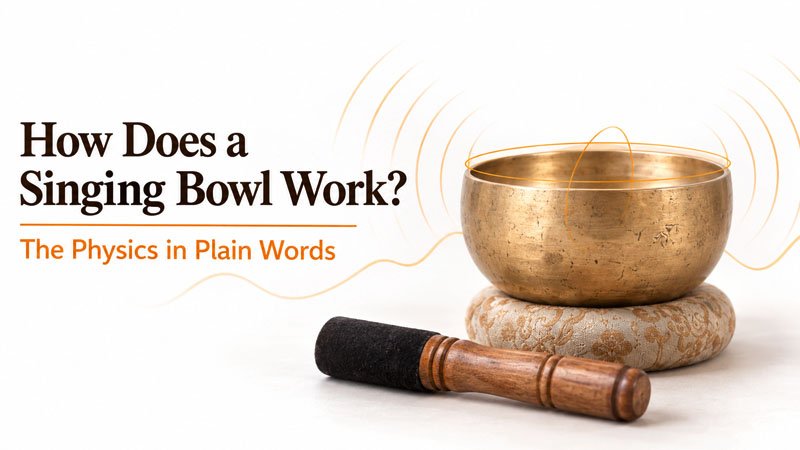
A singing bowl works like a bell. When you strike or rub it, the metal wall bends in and out very fast, the air around it is pushed in waves, and those waves reach your ear as sound.
Key takeaways
- The wall bends: the rim changes from a circle to an oval and back, many times a second.
- Striking gives one push. Rubbing gives many small pushes.
- Several tones ring at once, which is why the sound is rich.
- Size, shape and wall thickness decide the pitch.
What happens when you strike a singing bowl?
The mallet gives the wall one quick push. The metal springs back, goes too far, and springs back again.
- The rim bends from a circle into an oval, then into an oval the other way.
- Four points stay almost still while the parts between them move.
- The air is pushed by the moving wall, and the push travels outward as a sound wave.
- The sound fades as the bowl slowly gives its energy to the air.
The movement is far too small and fast to see. You can feel it by touching the rim lightly with a fingertip.
Why does the bowl sing when you rub the rim?
Because of grip and slip. The mallet grips the rim, slips, and grips again, many times each second.
Each small grip gives the rim a push at just the right moment, so the sound builds up and keeps going. A violin bow keeps a string sounding in the same way.
Our lesson on how to play a singing bowl teaches both ways, step by step.
Why do you hear more than one tone?
The wall can bend in several patterns at the same time. Each pattern has its own pitch.
| What you hear | What is happening in the metal |
|---|---|
| The main tone | The simplest bend, with four still points on the rim |
| Higher tones above it | Bends with more still points, moving faster |
| A slow pulse or wobble | Two tones very close in pitch, mixing together |
| A long ring | The metal loses its energy slowly |
A soft, padded mallet brings out the main tone. A hard wooden mallet brings out more of the higher tones.
Want to hear it for yourself?
See our hand-hammered singing bowls. A mallet and cushion come with every bowl.
What decides the pitch of a bowl?
- Width: a wider bowl usually gives a lower tone.
- Wall thickness: a thicker wall usually gives a higher tone.
- Shape: the curve of the wall and the lip change the mix of tones.
- The metal: bronze is springy and loses energy slowly, so it rings for a long time.
This is why a hand-hammered bowl's note is discovered, not made. Small differences in the wall, left by the hammer, decide the note, and nobody can know it until the bowl is finished and played.
You can read the note of any bowl with our free live singing bowl tuner. More detail is in 12 factors that affect singing bowl frequency.
Why does water in the bowl move?
The bending wall pushes the water at the edge and makes small waves. With a strong ring, drops jump from the surface.
Researchers studied this with high speed cameras in a paper called Tibetan singing bowls. We explain what it does and does not show in the singing bowl water experiment.
What does the physics not tell you?
Physics explains how the sound is made. It does not show that a bowl treats any condition.
A bowl supports relaxation and an attentive state. For what studies do and do not say, read do singing bowls actually work.
What are the common mistakes?
- Gripping the wall: fingers on the wall stop it bending, so the sound dies.
- Rubbing too fast: the mallet skips and the bowl rattles.
- Pressing too lightly: there is no grip, so there is no sound.
- A bare hard table: the base cannot move freely. Use the cushion.
What should you do next?
- Know the parts: read the anatomy of a singing bowl.
- Compare bowls: read why every singing bowl sounds different.
- Choose your own: pick size and finish on the custom singing bowl page.
- Learn to play: take the free singing bowl healing course.
Frequently asked questions
How does a singing bowl make its sound?
When you strike or rub it, the metal wall bends in and out very fast. That movement pushes the air, and the moving air reaches your ear as sound.
Why does a singing bowl sing when you rub the rim?
The mallet grips the rim, slips, and grips again many times a second. Each small grip gives the rim a push, in the same way a bow keeps a violin string sounding.
Why does a singing bowl have more than one tone?
The wall can bend in several patterns at the same time, and each pattern has its own pitch. You hear a main tone with higher tones above it.
Why does every singing bowl sound different?
The pitch depends on the size, shape and wall thickness. A hand-hammered wall is never perfectly even, so each bowl has its own sound.
Why does the sound of a bowl pulse or wobble?
Two tones that are very close in pitch mix together and make a slow rise and fall in loudness. An uneven hand-hammered wall often produces this.
Does a bigger singing bowl sound lower?
Usually, yes. A wider bowl usually gives a lower tone and a thicker wall usually gives a higher one, so two bowls of the same width can still differ.
Why does water in a singing bowl move?
The bending wall pushes the water at the edge and makes small waves. With a strong enough ring, drops jump from the surface.
Find the note of your bowl
Strike your bowl near your phone and our free tuner shows its note in seconds.