




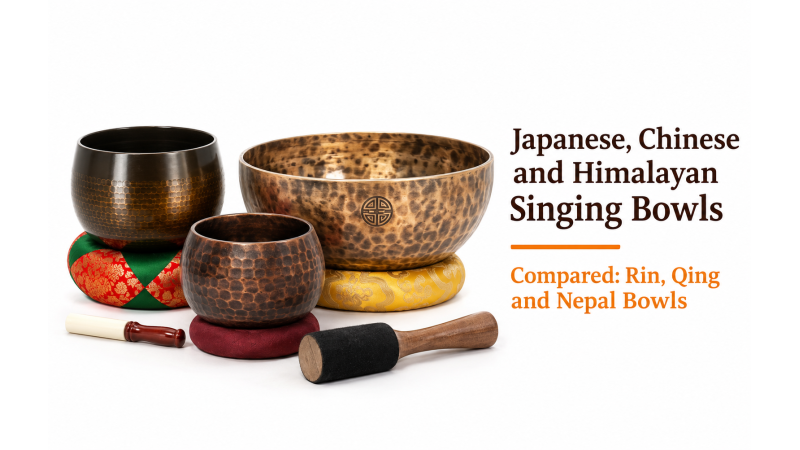
Japanese, Chinese and Himalayan Singing Bowls Compared
A Japanese singing bowl, the rin, and a Chinese singing bowl, the qing, are Buddhist bowl bells struck with a stick to mark the moments of chanting. A Himalayan singing bowl is a wide, hand-hammered bronze bowl from Nepal that is both struck and rimmed, giving a layered, singing tone. Choose a rin or qing for one clear chime, and a Himalayan bowl for meditation, sound baths and rimming.
Whichever you choose, the bowl is a sound to rest your attention on. Like any sound practice, it supports relaxation and focus, and does not treat any condition.
Key takeaways
- Japanese rin: struck on a small cushion to mark the start, pauses and end of a chant.
- Chinese qing: a small hammered bronze bowl that cues the chanting, paired with the wooden fish.
- Himalayan singing bowl: hand-hammered in Nepal, played by striking or by circling the rim.
- Rimming is the difference: Buddhist ritual strikes bowls; the singing tone is a Himalayan bowl's strength.
What is a Japanese singing bowl?
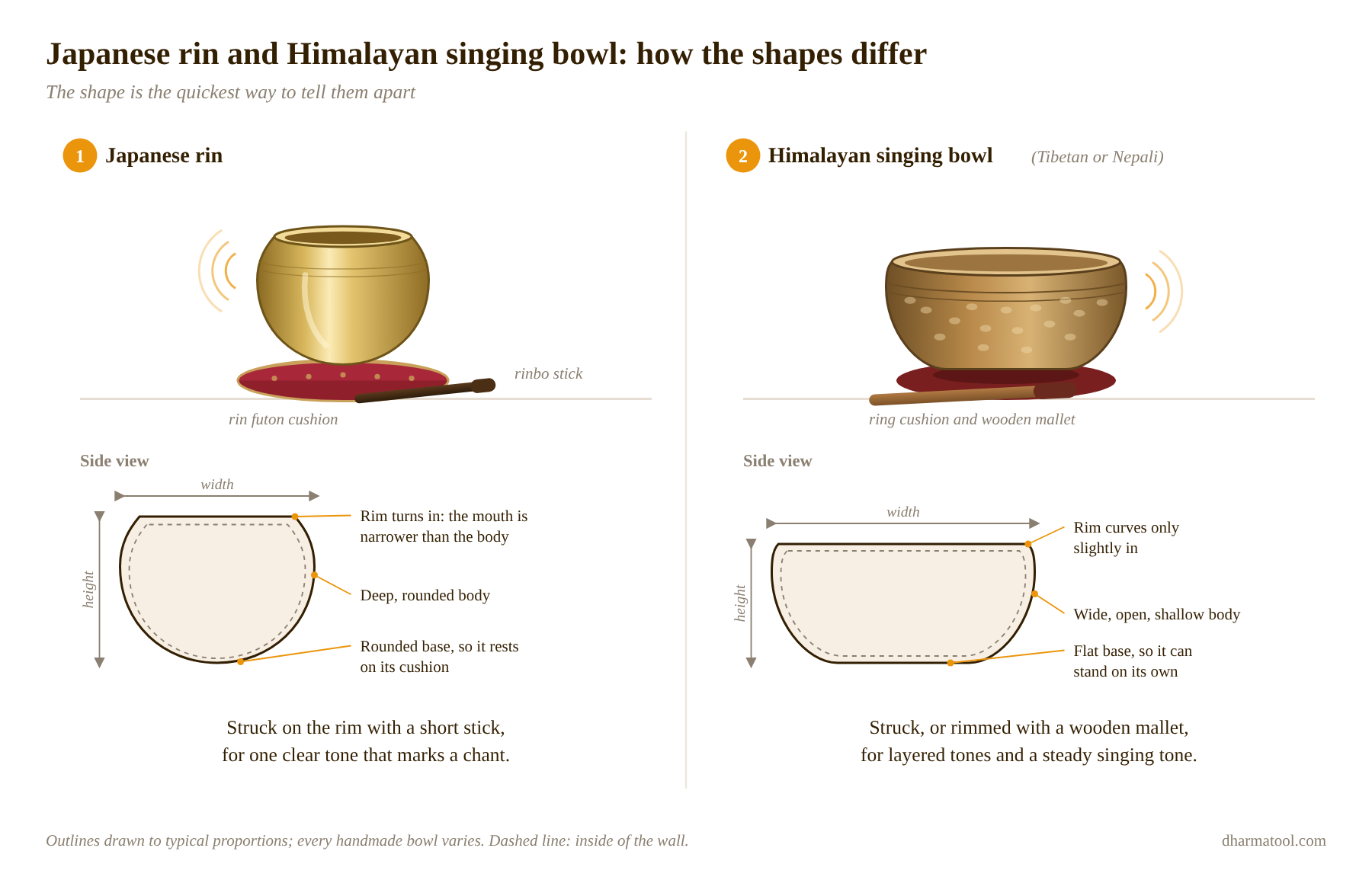
A Japanese singing bowl is a rin, often called orin at home, a bowl-shaped bell used in Buddhist services. It sits on a small cushion called a rin futon and is struck on the rim with a short stick called a rinbo, bachi or bai. Larger temple versions are called kin, kinsu or kei, and sizes run from about 6 to 90 cm across.
The rin is rung to mark the start, a pause and the end of a chant, and to signal when to release praying hands, as the Japanese Wiki Corpus describes. Small rin also sit on home altars for daily worship. Temple rin often have a thick rim, a dark colour and a lacquer finish.
What is a Chinese singing bowl?
In Chinese Buddhist temples the bowl bell is the qing, typically a hammered bronze bowl about 10 to 15 cm across. It is struck with a wooden stick during chanting and is usually paired with the muyu, the wooden fish block. Each strike tells the room when to join palms, release them, speed up, slow down, start or stop, as The Buddhist Garden explains.
Larger temple bowls, the da qing, lead the chanting. Like the Japanese rin, the qing is made to be struck, not rimmed.
A Chinese spouting bowl is a different object: a metal basin with two handles. Rubbing the handles with damp hands makes the water inside ripple and jump up in droplets, and such bowls are said to date back around 2,500 years.
What is a Himalayan singing bowl?
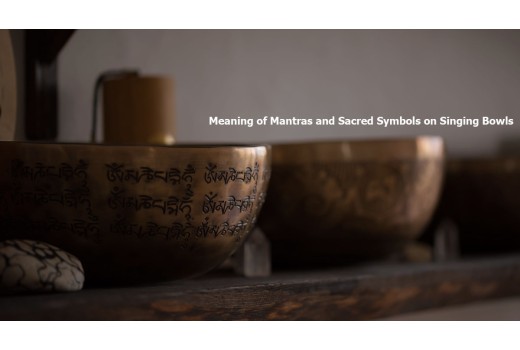
A Himalayan singing bowl is a wide bowl of bell bronze, an alloy of copper and tin. Most are hand-hammered in Nepal, while some are cast and then carved by hand. Our guide to how Tibetan singing bowls are made shows each step.
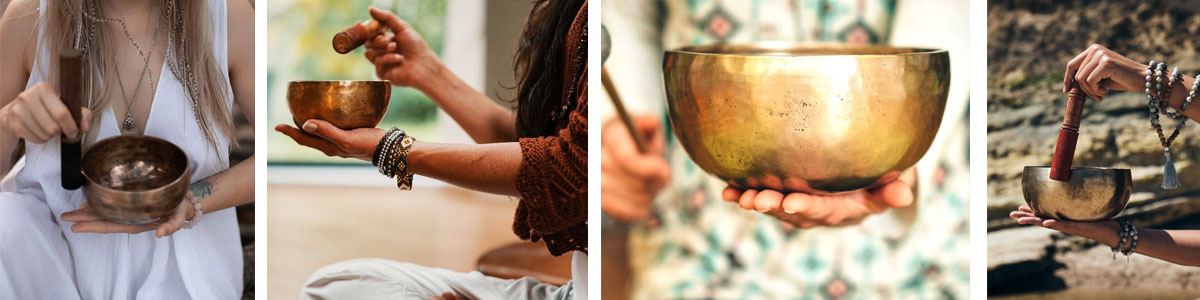
It is played two ways: struck for a single tone, or rimmed by circling a wooden mallet around the outside to build a steady singing tone. How loud the singing tone grows depends on the speed and pressure of the mallet. Because several tones ring together, the sound feels fuller and more layered than a rin or a qing.
Most bowls sold as Tibetan singing bowls are made in Nepal and northern India; our guide to where singing bowls are made explains the names. Bowls that could sing began reaching the West in the early 1970s, according to Wikipedia's history of standing bells.
Japanese vs Chinese vs Himalayan singing bowls at a glance
| Japanese rin | Chinese qing | Himalayan singing bowl | |
|---|---|---|---|
| Also called | Orin; kin, kinsu or kei in temples | Bowl bell; da qing for large temple bowls | Tibetan singing bowl, Nepal singing bowl |
| Where it is used | Temples and home altars | Temples, during chanting | Meditation, sound baths and home practice |
| How it is played | Struck with a short stick | Struck with a wooden stick | Struck, or rimmed with a wooden mallet |
| What it rests on | A rin futon cushion on a small stand | A cushion | A ring cushion or the palm of your hand |
| Size | About 6 to 90 cm across | Usually 10 to 15 cm; larger in big temples | Palm size up to large standing bowls |
| Sound | One clear tone that marks the chant | A bright ring that cues the chant | Layered tones, and a steady singing tone when rimmed |
Can you rim a Japanese or Chinese bowl?
Japanese and Chinese bowls are made and used to be struck, and Buddhist ritual does not use the singing, or rimming, mode at all. Making bowls to sing is a modern practice. That is why the Himalayan bowl is the usual choice when you want to rim.
Which one should you choose?
| If you want | Choose |
|---|---|
| One clear chime to open and close chanting | A Japanese rin, or a small Himalayan bowl struck once |
| A tone to follow in meditation | A Himalayan meditation bowl |
| A bowl you can rim for a steady singing tone | A hand-hammered Himalayan bowl |
| Bowls for a sound bath or chakra session | A chakra singing bowl set |
We make only Himalayan bowls, hand-hammered or hand-cast in Nepal, and do not sell Japanese or Chinese bowls. If you want a bell to open and close a sitting, our meditation bell guide compares the singing bowl with tingsha, the Tibetan bell and the Burma bell.

How to tell which bowl you are buying
- Hammer marks: small dents inside and out show a hand-hammered Himalayan bowl.
- Fine, even rings: circular lines all round the bowl usually mean it was turned on a machine lathe.
- A cushion, a stick and a thick rim: the usual signs of a Japanese rin.
- Two handles: a Chinese spouting bowl, not a singing bowl.
Ask the seller where and how the bowl was made, and what metal it is. Our guides on checking an authentic singing bowl and bronze vs brass singing bowls show what to look for.
Why we make Himalayan bowls in Kathmandu
Every Dharma Tool bowl is made in Nepal, and played and selected by Sunita for each order before it leaves Kathmandu. Our meditation singing bowls are chosen for a steady note and a long sustain, and a 6 inch mantra-etched singing bowl is a good first bowl.
A custom singing bowl can carry your own mantra, a name or a date, engraved free of charge. You can also build a matched set with our singing bowl set builder, and every order leaves Kathmandu within 3 to 4 business days by DHL Express.
Learn more, free
To see every Himalayan bowl family, from jambati to thadobati, read our guide to the types of singing bowls. How an everyday utensil became a singing bowl is told in the origin of the singing bowl.
Our free singing bowl healing course is designed from Sunita's own notebook. It takes you from your first strike to full sessions, one short lesson at a time.
Find your Himalayan singing bowl
Hand-hammered singing bowls from Nepal, played and selected by a sound healer before they leave Kathmandu.
| If you want | Look at |
|---|---|
| A hand-hammered Himalayan bowl | Handmade singing bowls |
| A bowl for daily meditation | Meditation singing bowls |
| A first bowl with a mantra | 6 inch mantra-etched singing bowl |
| A set for sound baths | Chakra singing bowl sets |
| Your own mantra, name or date | Custom singing bowl |
| A matched set of your own | Singing bowl set builder |
Frequently asked questions
What is a Japanese singing bowl called?
It is called a rin, or orin, and larger temple versions are called kin, kinsu or kei. It sits on a small cushion called a rin futon and is struck with a short stick called a rinbo.
Is a Japanese rin the same as a Tibetan singing bowl?
No. Both are bowl-shaped bells, but a rin is made to be struck during Buddhist services and at home altars. A Himalayan, or Tibetan, singing bowl is hand-hammered in Nepal and played by striking or by circling the rim.
What is a Chinese singing bowl?
In Chinese Buddhist temples the bowl bell is the qing, a small hammered bronze bowl struck with a wooden stick during chanting. It is usually paired with the muyu, the wooden fish block.
What is a Chinese spouting bowl?
A spouting bowl is a metal basin with two handles. Rubbing the handles with damp hands makes the water inside ripple and jump up in droplets.
Can you rim a Japanese or Chinese bowl?
They are made and used to be struck, and Buddhist ritual does not use the rimming mode at all. If you want a steady singing tone, choose a Himalayan bowl.
Which singing bowl is best for meditation?
For a single chime to open and close a sitting, any of the three works. For a tone you can follow and a bowl you can rim, a hand-hammered Himalayan bowl is the usual choice.
Are Tibetan singing bowls made in Tibet?
Most bowls sold as Tibetan singing bowls are made in Nepal and northern India. The name describes the style and tradition rather than the country of making.
Why does a Himalayan bowl sound different from a Japanese rin?
A Himalayan bowl is wide, hand-hammered bell bronze, so several tones ring together in a layered sound. A rin gives one clear tone, made to mark the moments of a service.
Learn from Sunita's notebook, free
From your first strike to a full session, with the free singing bowl healing course.