




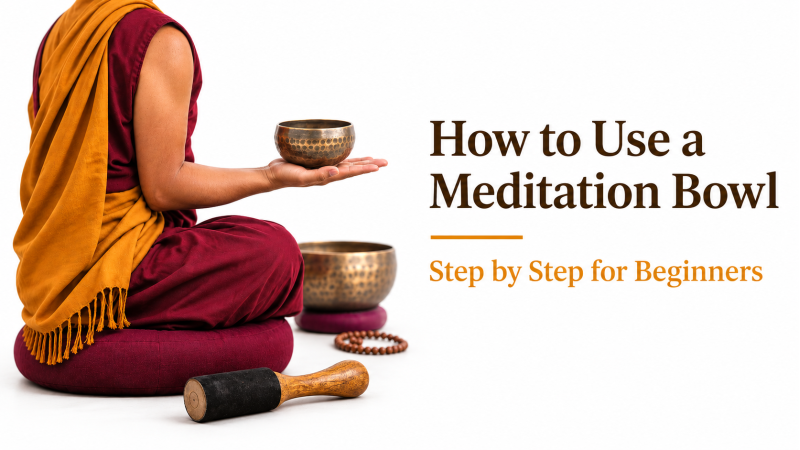
How to Use a Meditation Bowl - Step by Step for Beginners
To use a meditation bowl, sit upright with the bowl on your palm or a cushion, strike the rim once with the mallet, and rest your attention on the tone until it fades completely. Strike again when the sound is gone, or circle the mallet around the rim for a steady tone, then close with one final strike. Five to ten minutes a day is enough to begin.
A meditation bowl is simply a Himalayan singing bowl used as a sound to follow. Singing bowl meditation is one of the easiest ways for beginners to start sitting, because the tone gives a wandering mind something to come back to. Like any sound practice, it supports relaxation and focus, and does not treat any condition.
Key takeaways
- Strike once, follow the tone: the simplest way to meditate with a singing bowl.
- Rim for a steady tone: circle the mallet slowly around the outside of the rim.
- Start with 5 to 10 minutes, then build up to 20 when it feels easy.
- Small bowls in the palm, larger bowls on a ring cushion.
What you need to use a meditation bowl
| What you need | Why it matters |
|---|---|
| A meditation bowl | 5 to 7 inches sits in the palm; 8 inches and up rests on a cushion |
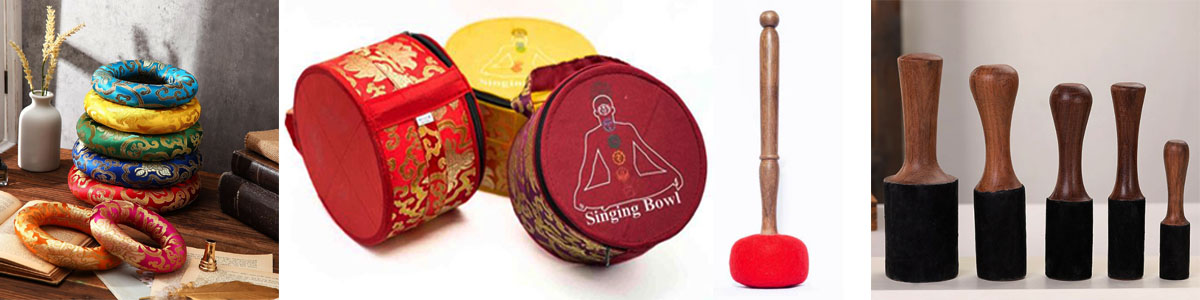
| A mallet | Wooden for a bright strike and for rimming; a felt or suede-wrapped end for a warmer tone |
| A ring cushion | Lets a larger bowl ring freely without sliding |
| A quiet seat | A cushion or chair where you can sit upright for 10 minutes |
Our meditation singing bowls are chosen for a steady note and a long sustain, and every bowl is played and selected by Sunita for each order before it leaves Kathmandu. Mallets and ring cushions are in our singing bowl accessories.

How to use a meditation bowl, step by step for beginners
These eight steps show how to use a singing bowl for meditation, whether it sits in your palm or on a cushion. They are also how to use a Tibetan singing bowl, often called a Tibetan prayer bowl, for any quiet practice at home.
- Sit comfortably: on a cushion or chair, back upright, shoulders relaxed, eyes half closed.
- Place the bowl: rest a small bowl on a flat palm with your fingers spread and away from the sides, or set a larger bowl on a ring cushion in front of you.
- Breathe first: take three slow breaths before the first sound.
- Strike once: tap the outside wall just below the rim with the padded end of the mallet, gently, as if knocking on a door.
- Follow the tone: rest your attention on the sound as it swells and fades, all the way to silence.
- Strike again: only when the tone has completely gone. If your mind wandered, the new tone brings it back.
- Rim if you like: hold the mallet upright against the outside rim and circle slowly with steady pressure until the bowl begins to sing.
- Close: strike once more, sit until the silence returns, and notice how you feel before you get up.
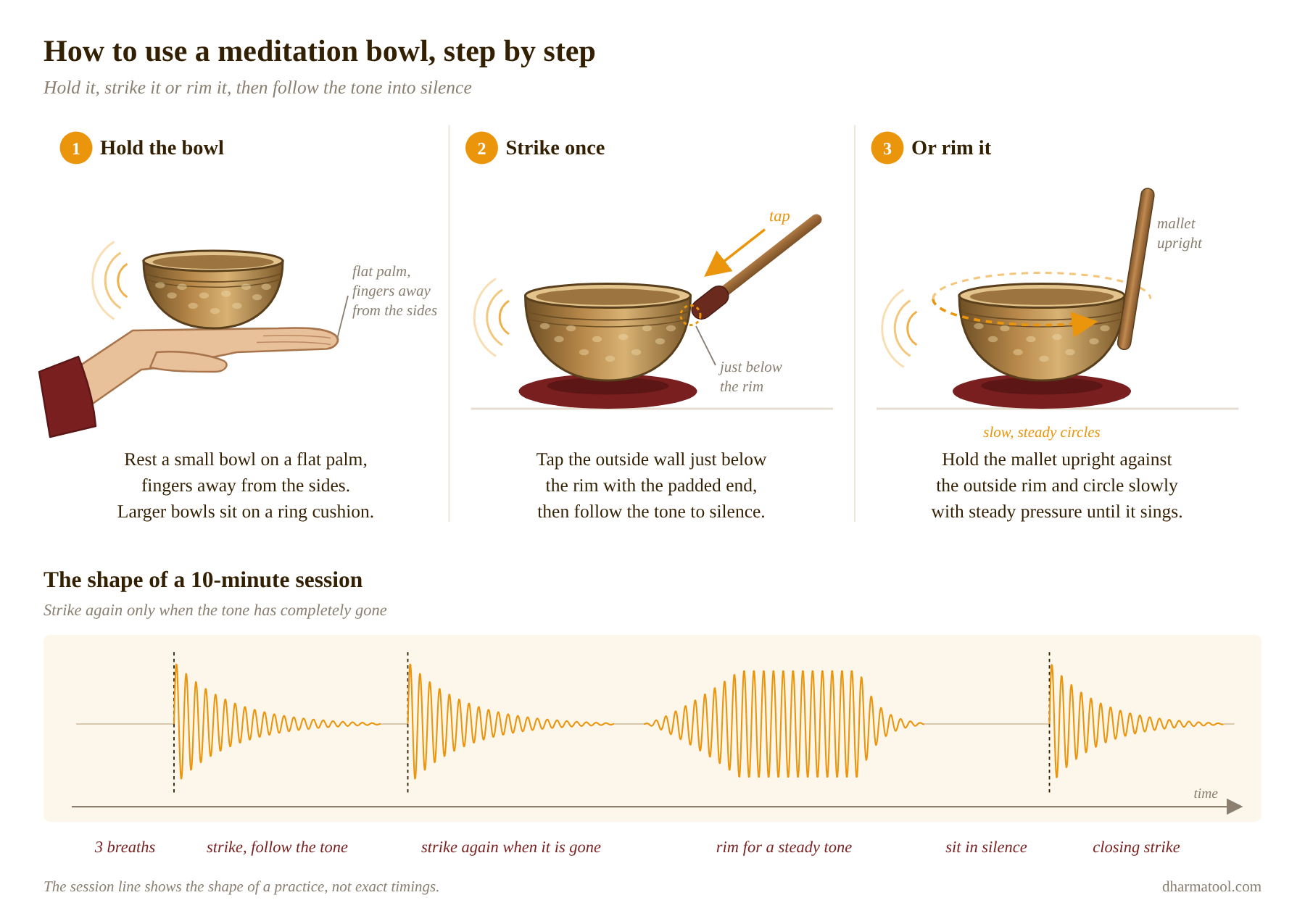
For photos of each hold and mallet angle, see our full guide on how to play a singing bowl.
Strike or rim: which is better for meditation?
| Method | What you hear | Best for |
|---|---|---|
| Striking | One clear tone that rises and slowly fades | Opening and closing, and following the tone into silence |
| Rimming | A steady, continuous tone that builds while you circle | Longer focus, and settling a busy mind |
| Strike, then rim | A strike that you keep alive by circling the rim | Moving from one tone into a longer sound |
Most beginners start with striking, because there is nothing to get wrong. Rimming takes a little practice; our singing bowl mallet guide explains which mallet makes it easier.
How long should you meditate with a singing bowl?
| Stage | Session | How to play |
|---|---|---|
| First week | 5 minutes | One strike, follow the tone, strike again only when it is completely gone |
| Daily practice | 10 minutes | Strike to open, a few strikes or one rimming, silence, strike to close |
| Deeper practice | 20 minutes | Alternate strikes and rimming, then sit the last 5 minutes in silence |
A short session done every day is worth more than a long one done once a week. Our free 30-day singing bowl routine calendar gives you one short practice for each day.
Three simple meditation bowl practices
- Tone following: strike, follow the tone to silence, strike again. Count the strikes up to ten, then start again.
- Breathing with the bowl: strike, then breathe out slowly for as long as the tone lasts; our voo breathing guide builds on this.
- Humming with the bowl: strike and hum softly under the tone, letting your voice and the bowl ring together, as in our voice toning guide.
If silent meditation has always felt hard, our guide to meditation with a singing bowl explains why a sound to follow makes it easier.
Why won't my singing bowl sing?
| Problem | Usual cause | What to do |
|---|---|---|
| It squeals or screeches | Circling too fast or pressing too hard | Slow down, ease the pressure, or use the wrapped end of the mallet |
| It rattles or buzzes | The mallet is bouncing, or a finger is touching the wall | Keep the mallet in steady contact and rest the bowl on a flat palm or cushion |
| The sound breaks up | Uneven speed or pressure | Move from the whole arm, not the wrist, at the same speed each circle |
| Nothing builds | Too little contact or the wrong angle | Press a little more, hold the mallet upright, and give it three or four slow circles |
| It takes long to sing | Normal for larger or thicker bowls | Keep going; the tone needs time to build |
Large and thick bowls simply take longer, as our guide to why a singing bowl takes time to sing explains. If the sound still seems wrong, check our guide is my singing bowl faulty.
Choosing your meditation bowl
For meditation at home, a hand-hammered bowl of 5 to 7 inches is the easiest to hold and play. A 6 inch mantra-etched singing bowl is a good first choice, because the carved mantra also gives your eyes a point of focus.
A custom singing bowl can carry your own mantra, a name or a date, engraved free of charge. Every order leaves Kathmandu within 3 to 4 business days by DHL Express.
A meditation bowl also works as a meditation bell to open and close any sitting; our meditation bell guide compares it with tingsha and the Tibetan bell.
Learn more, free
Our free singing bowl healing course is designed from Sunita's own notebook. It takes you from your first strike to full sessions, one short lesson at a time.
Find your meditation bowl
Hand-hammered singing bowls from Nepal, played and selected by a sound healer before they leave Kathmandu.
| If you want | Look at |
|---|---|
| A bowl for meditation | Meditation singing bowls |
| A first meditation bowl with a mantra | 6 inch mantra-etched singing bowl |
| A mallet or ring cushion | Singing bowl accessories |
| A bowl with your own mantra or name | Custom singing bowl |
| A daily practice to follow | 30-day singing bowl routine calendar |
Frequently asked questions
How do you use a meditation bowl?
Sit upright with the bowl on your palm or a cushion, strike the rim once and follow the tone until it fades. Strike again when the sound is gone, or circle the rim for a steady tone, and end with one final strike.
Do you strike or rub a singing bowl for meditation?
Both work. Striking gives one tone to follow into silence, and rubbing the rim gives a steady tone; most beginners start by striking.
How long should I meditate with a singing bowl?
Start with 5 minutes in the first week, then 10 minutes a day. Once that feels easy, a 20-minute session with silence at the end works well.
How often should I strike the bowl during meditation?
Strike again only when the previous tone has completely faded. For most bowls that means once every 30 seconds to a minute.
Should I hold the bowl or put it on a cushion?
Hold a small bowl of 5 to 7 inches on a flat palm, with your fingers away from the sides. Place larger bowls on a ring cushion so they can ring freely.
Why does my singing bowl rattle?
Rattling usually means the mallet is bouncing off the rim or a finger is touching the wall. Keep the mallet in steady contact and rest the bowl on a flat palm or cushion.
Which side of the mallet should I use?
Use the padded or wrapped end for a warm strike, and the plain wooden side for rimming and a brighter tone.
Is a meditation bowl the same as a Tibetan singing bowl?
Yes. Meditation bowl, Tibetan singing bowl, Himalayan bowl and Tibetan prayer bowl are names for the same hand-hammered bowl. Meditation bowl simply describes how it is used.
Is it okay to use a meditation bowl every day?
Yes. A short daily session is the best way to build the habit. Like any sound practice, it supports relaxation and focus, and does not treat any condition.
Learn from Sunita's notebook, free
From your first strike to a full session, with the free singing bowl healing course.