




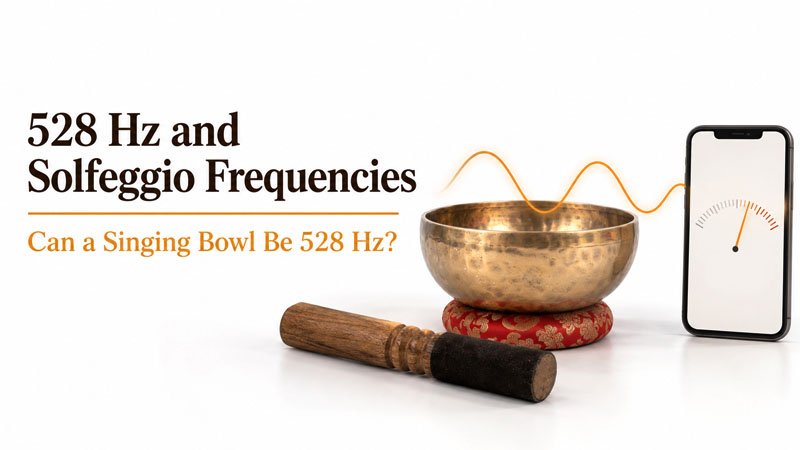
528 Hz and Solfeggio Frequencies - Can a Singing Bowl Be 528 Hz?
Yes, a singing bowl's main tone can sit at or close to 528 Hz. On a tuner it reads as a C, a little high, and it is found by choosing among finished bowls, because nobody can hammer a bowl to an exact number.
Key takeaways
- 528 Hz is a C, about 16 cents high on a standard tuner.
- Found, not made: a hand-hammered bowl's note is discovered.
- Solfeggio claims are widely reported, not measured.
- To get one: ask for it, and check it with a tuner.
What note is 528 Hz?
In standard tuning, the C above middle C rings at about 523 Hz. 528 Hz sits just above it, about 16 cents high, which is a small fraction of the step to C#.
It is also two octaves above the low C near 131 Hz, the C in our course chart for the Root. So a 528 Hz bowl belongs with the C note family.
The difference between tuning standards is explained in 432 Hz vs 440 Hz singing bowls.
What are the solfeggio frequencies?
They are a set of six numbers often linked with healing music: 396, 417, 528, 639, 741 and 852 Hz.
| Frequency | Nearest note on a standard tuner | How close |
|---|---|---|
| 396 Hz | G | 18 cents high |
| 417 Hz | G# | 7 cents high |
| 528 Hz | C | 16 cents high |
| 639 Hz | D# | 46 cents high, close to halfway to E |
| 741 Hz | F# | 2 cents high |
| 852 Hz | G# | 44 cents high, close to halfway to A |
The set became popular in the late twentieth century. It is often said to come from an old hymn, and that story is widely reported but not documented.
What is claimed, and what is known?
- Claimed: 528 Hz is called the "love frequency" and is said to repair DNA.
- Known: no study has shown either claim. They are widely reported, not measured.
- What a bowl does: any bowl you enjoy supports relaxation and an attentive state. No frequency treats a condition.
For what research does say about bowls, read do singing bowls actually work.
Want a bowl close to 528 Hz?
Ask for it on the custom singing bowl page. Sunita plays the bowls in your size after the order arrives and chooses one that rings close to 528 Hz.
Can a hand-hammered bowl be tuned to 528 Hz?
No. A hand-hammered bowl's note is discovered, not made. The hammer decides the size, shape and wall, and those decide the note.
- Chosen, not tuned: a bowl near 528 Hz is found among finished bowls.
- Close, not exact: the reading moves a little as the sound fades, so expect "close to 528", not 528.00.
- Several tones: a bowl rings with a main tone and higher tones above it. Make sure 528 Hz is the main tone.
- Usually smaller: a smaller bowl usually sounds higher, so a main tone near 528 Hz tends to come from a smaller bowl.
Read 12 factors that affect singing bowl frequency for the rest.
How do you check a bowl for 528 Hz?
- Open the tuner: our free live singing bowl tuner.
- Strike softly with a padded mallet, so the main tone comes through.
- Read the first steady number, not the sharp sound at the strike.
- Look for C with a small plus reading, close to 528 Hz.
More help is in how to find your singing bowl's note and sharps and flats on singing bowls.
Which bowls should you look at?
| If you want | Look at |
|---|---|
| A bowl chosen close to 528 Hz | Custom singing bowl, where you ask for it |
| A bowl in the C note | Note select singing bowl |
| Any hand-hammered bowl | Hand-hammered singing bowls |
What are the common mistakes?
- Believing "tuned to 528 Hz" on a hand-hammered bowl.
- Reading the strike: the first sharp sound is not the main tone.
- Chasing 528.00: a few hertz either way is normal.
- Paying for a promise: no frequency has been shown to heal.
What should you do next?
- Read about 432 Hz: see 432 Hz singing bowls.
- Understand frequency: read does singing bowl frequency matter.
- Learn the notes: take the free singing bowl healing course.
Frequently asked questions
Can a singing bowl be 528 Hz?
Yes, a bowl's main tone can sit at or close to 528 Hz. Nobody can hammer a bowl to an exact number, so it is found by choosing among finished bowls.
What note is 528 Hz?
On a standard tuner, 528 Hz reads as a C, about 16 cents high. It is two octaves above the low C near 131 Hz.
What are the solfeggio frequencies?
A set of six numbers usually listed as 396, 417, 528, 639, 741 and 852 Hz. They became popular in the late twentieth century, and their link to an old hymn is widely reported but not documented.
Does 528 Hz repair DNA?
That claim is widely reported but not measured. No study has shown that a 528 Hz sound repairs DNA or treats any condition.
Is a 528 Hz singing bowl better than other bowls?
Not in any way that has been shown. A bowl near 528 Hz supports relaxation like any bowl you enjoy.
How do I check if a bowl is 528 Hz?
Strike it near our free live singing bowl tuner. Look for C with a small plus reading, and a frequency close to 528 Hz.
What about bowls sold as tuned to 528 Hz?
Ask how the number was measured. A hand-hammered bowl's note is discovered, not made, so a seller can only choose a bowl that rings close to 528 Hz.
Check your own bowl
Strike your bowl near your phone and our free tuner shows its note and frequency in seconds.