




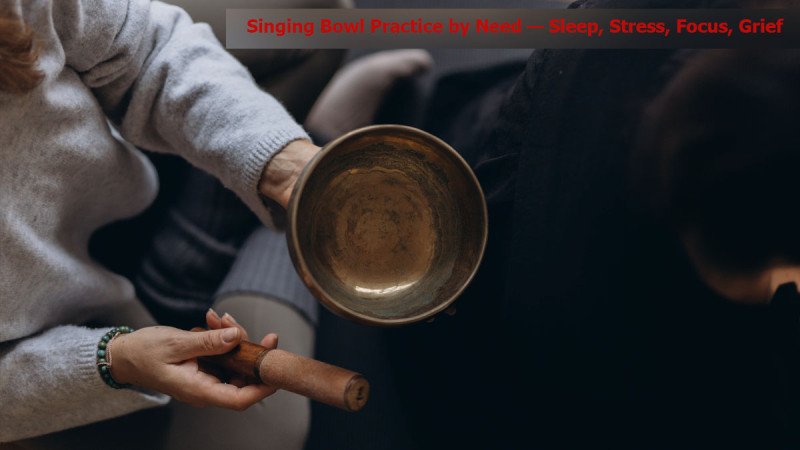
Which Singing Bowl Practice Fits What You Need?
Sound works differently depending on what you bring to it. For sleep, low tones and a long fade before bed. For an overactive nervous system, felt vibration from a large bowl at close range. For attention, a single clear strike as a transition cue. For emotional difficulty, sustained sound that asks nothing of you. The instrument is the same. What changes is the size of bowl, the technique, and the time of day.
Most people arrive at singing bowls for a specific reason. Sleep that will not come. A mind that will not stop. Grief that has nowhere to go. A practice that has stalled.
The general advice — sit quietly, play the bowl, feel better — is not wrong, but it is not much use either. What actually helps is knowing which approach suits which problem, and that varies considerably.
This page is a map. Find what brought you here, and it will point you to the practice, the technique and the kind of bowl that suits it.
If you would rather go straight to the instruments, our bowls are grouped the same way: Deep Sleep, Calm Mind for stress and anxiety, Clear Mind for focus, and Meditation.
Sleep and Rest
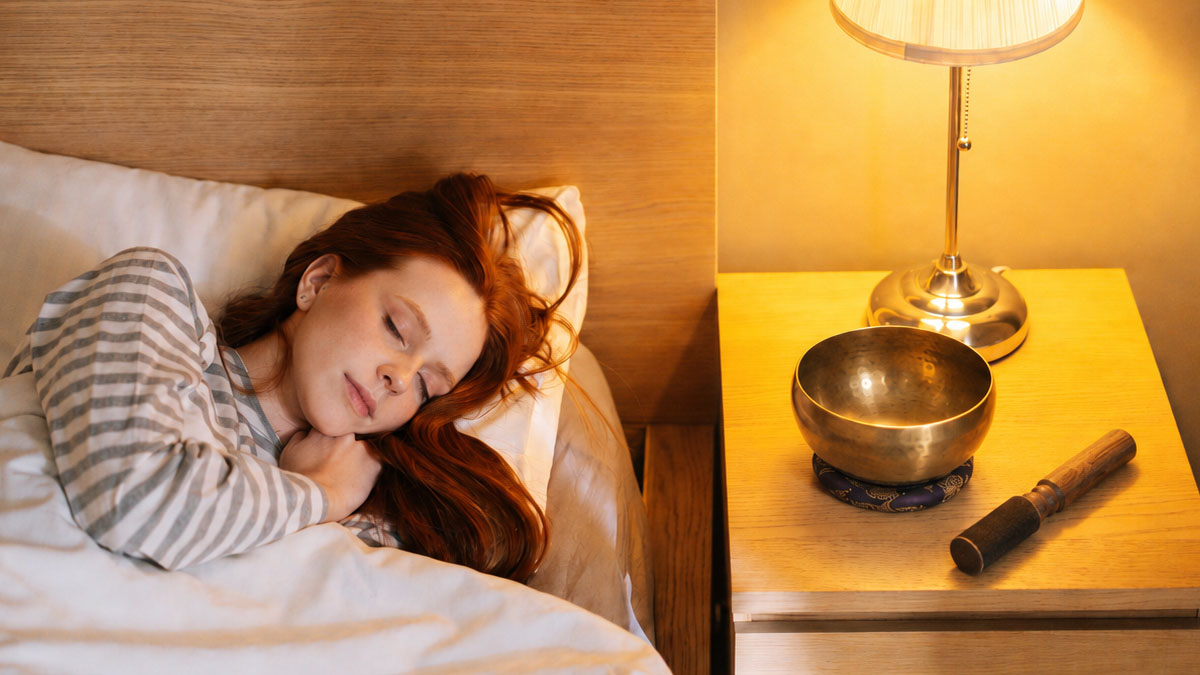
Sound suits sleep for a mechanical reason: the pattern that precedes sleep — slower breathing, dropping muscle tone, a shift toward parasympathetic dominance — is the same pattern a sustained low tone produces. You are not being lulled. You are being moved into a physiological state you were going to need anyway.
What works: Low, slow, and finishing well before you get into bed. A large bowl struck a handful of times, each tone followed all the way to silence. Ten minutes is plenty. The aim is to arrive at bed already downshifted rather than to fall asleep to sound.
What to avoid: Bright, high bowls late at night — they alert rather than settle. And playing right up to the moment you lie down, which leaves no transition.
Shop: Deep Sleep Singing Bowls — bowls selected for the low fundamental and long fade this work needs.
Read: Singing Bowl Sound Before Sleeping
Stress and the Nervous System
This is the area with the most evidence behind it. Sustained low-frequency sound supports parasympathetic activation, slows breathing without instruction, and has produced measurable improvement in heart rate variability in controlled study.
What works: Proximity and size. The felt component of a bowl — the part you register in your chest and through the floor rather than at ear level — is what does the work here, and it requires a large bowl within about a metre. Bare feet on a hard floor help considerably.
Frequency of practice: Short and daily beats long and occasional. Five to ten minutes most days builds the response. An hour once a fortnight does not.
Shop: Calm Mind Singing Bowls — chosen for depth of tone and the felt component that carries this work.
Read: The Vagus Nerve and Singing Bowl Sound · How to Start Singing Bowl Sound Healing at Home

Attention, Focus and a Mind That Will Not Settle
Sound helps attention in a way that is often misunderstood. It does not improve concentration directly. It works as a transition cue — an external marker that one thing has ended and another begins, which is exactly the moment most people struggle with.
What works: One clear strike before the task, listened to all the way down, then straight into the work with no gap. The association builds over weeks until the sound alone starts doing part of the job.
Bowl choice: The opposite of what suits sleep. A smaller, brighter bowl with a clean fundamental is easier to follow to silence and cuts through mental noise more cleanly than a deep one.
Shop: Clear Mind Singing Bowls — bright, clean-toned bowls that work well as a transition cue.
Read: Singing Bowl for Clear Mind and Focus · Can't Meditate? A Singing Bowl Can Help
Grief and Emotional Difficulty
The useful property of a singing bowl in emotional work is that it asks nothing. There is nothing to interpret, nothing to follow, no requirement to describe what you are feeling. For anyone tired of being asked how they are, that absence of demand is the point.
What works: Sustained sound, long fades, and permission to do nothing at all. No structure, no counting, no goal. Ten minutes of listening.
Worth knowing: Sound can bring emotion to the surface, which is often useful and occasionally more than expected. Shorter sessions and the freedom to stop at any point matter more than duration.
Shop: Calm Mind Singing Bowls — long sustain and a soft attack, which is what emotional work asks for.
Read: Singing Bowls for Grief and Emotional Healing
Bowls grouped by what you need them for
Low tones settle a nervous system; bright ones sharpen attention. Rather than sorting by size, start from the purpose: Deep Sleep bowls, Calm Mind bowls for stress and anxiety, Clear Mind bowls for focus, or Meditation bowls for daily sitting.
Meditation and Contemplative Practice
Meditation is where these instruments have the longest association, and the most common reason people struggle with it is that they are trying too hard. A bowl removes the effort by giving attention something external to rest on.
The core practice: Strike once. Listen until the sound has completely gone. Notice the beginning, the fullness, the softening, and the silence after. Repeat three to five times. That is a complete session and it takes under ten minutes.
Why it works when other approaches do not: It has a defined start, a defined end, and immediate feedback. Twenty minutes of watching the breath has none of those, which is why so many people give up on it.
Shop: Meditation Singing Bowls — the balanced mid-range that suits daily sitting.
Read: Singing Bowl for Meditation, Yoga and Mindful Practice · How to Build a Sacred Space at Home
Chakra and Energy Practice
Worth being clear about what this is. The mapping of the seven chakras to musical notes is a modern framework rather than an ancient inheritance — traditional bowls were not forged to notes at all.
That does not make it useless. A chakra sequence gives a session a shape, a practitioner an order to work in, and a client something to follow. Structure has real value in practice, and a framework earns its place by whether it helps rather than by how old it is.
What works: Moving root to crown in sequence, spending a few minutes at each. A full set gives you the range; a single bowl in a chosen note works fine for focused work.
Shop: Chakra Singing Bowl Sets — tuned sets of seven covering the full range.
Read: Chakra Note Information · The 9 Chakra System
Bodywork, Massage and Physical Practice
Where a bowl is placed on or beside the body, the mechanism changes. You are no longer working with sound but with mechanical vibration entering tissue directly — a different sense, different receptors, and different effects.
What works: Direct contact or very close proximity, and a large heavy bowl with a low fundamental. Nothing soft between the bowl and the body.
Important: Body placement is bodywork and has genuine contraindications — implanted electronic devices, pregnancy, recent surgery, thrombosis. Playing a bowl in the room is safe for essentially everyone; placing one on someone is not.
Shop: Large Standing Singing Bowls — the size and weight body-contact work requires.
Read: Singing Bowls in Massage Therapy · Head Therapy Singing Bowl Guide
Yoga, Teaching and Group Work
In a room with other people the priorities invert. The felt vibration that matters in personal practice reaches only the first row. What carries across a space is sound.
What works: A clear bowl that reaches everyone equally for opening and closing, and a large bowl for the sustained middle of a session where you want physical presence. One strike to open, sustained work through the body of the class, one strike to close.
The most common mistake: playing too loud. Volume is not intensity — a room held quietly draws people in, while a room filled aggressively leaves them braced.
Shop: Meditation Singing Bowls for the clear opening tone, and large standing bowls for the sustained middle of a class.
Read: Singing Bowls in Yoga — A Guide for Teachers · Singing Bowls and Reiki
Which Bowl for Which Need
Size determines the fundamental frequency, and fundamental frequency determines almost everything about how a bowl behaves. This table is the short version.
| What you need it for | What suits it | Why |
|---|---|---|
| Sleep and downregulation | Large, 25cm+, low fundamental | Low frequencies are felt physically and slow breathing without instruction |
| Stress and nervous system | Large, thick-walled, played close | The felt component does the work, and it falls away sharply with distance |
| Focus and transitions | Small to medium, 10-18cm, clear tone | A clean fundamental is easy to follow to silence and cuts through mental noise |
| Grief and emotional work | Medium to large, long sustain | Long fades give attention somewhere to rest without demanding anything |
| Daily meditation | Medium, 15-22cm | The balance point — audible and felt, and light enough to reach for daily |
| Chakra and energy work | A tuned set, or single bowls in chosen notes | The framework needs the range to be useful |
| Bodywork and placement | Large, heavy, low fundamental | Direct contact delivers vibration at full strength; weight helps |
| Teaching and groups | One clear bowl plus one large | Sound carries across a room; felt vibration does not |
If none of these quite fits — a specific note, a particular wall thickness, a matched pair — a custom-forged bowl lets you specify it rather than hoping the right one turns up.
Getting Started, Whatever Brought You Here
The practice underneath all of these is the same, and it takes about two minutes.
- Sit somewhere firm. Hard floor if you can, bare feet. Soft furniture absorbs the vibration you came for.
- Remove rings and bracelets. Metal against a vibrating bowl buzzes and damps the tone.
- Strike once, gently, about two thirds up the outer wall with a felt mallet. A soft strike gives a longer, cleaner fade than a hard one.
- Listen until it has completely gone. The last few seconds, where the tone is barely there, are the part that matters. Most people stop too early.
- Sit in the silence for a few breaths before doing anything else.
- Repeat three to five times. Then stop. Short and regular does considerably more than long and occasional.
If your bowl is not singing when you rim it, that is almost always technique rather than the instrument — our guide on how to play a singing bowl covers the common errors.
What Sound Can and Cannot Do
Worth stating plainly, because this page is organised around needs and some of those needs are serious.
What is reasonably supported: relaxation, reduced tension and fatigue, improved heart rate variability, better sleep quality, and a non-verbal route into body awareness. These findings come from small but real peer-reviewed studies.
What is not: treating or curing any condition. No specific frequency heals anything. Sound practice is a complement to proper care, not a substitute for it.
If you are dealing with persistent insomnia, clinical anxiety, depression, chronic pain or trauma, work with a qualified clinician. A singing bowl belongs alongside that care as one more thing that makes the days work slightly better — which is a real contribution, and a limited one.
Whatever you need it for, someone has already played it
Every bowl is assessed for sustain, tone quality and frequency stability before listing — because no two hand-forged bowls sound alike and a photograph tells you nothing. Browse the full collection, or commission a bowl to the note and size your practice calls for.
Frequently Asked Questions
Which singing bowl practice is best for sleep?
Low tones, played well before bed rather than at the moment of lying down. A large bowl struck a handful of times, each tone followed all the way to silence, for around ten minutes. The aim is to arrive at bed already downshifted. Avoid bright, high-pitched bowls late at night — they alert rather than settle.
What kind of bowl should I get for anxiety and stress?
A large bowl with a low fundamental, played within about a metre of you. The component that helps most with nervous system regulation is felt vibration rather than heard sound, and that falls away sharply with distance. Bare feet on a hard floor increase what reaches you considerably. Short daily sessions work better than occasional long ones.
Can a singing bowl help me focus?
Indirectly, and effectively. It works as a transition cue rather than by improving concentration — one clear strike before a task, listened to all the way down, then straight into the work. The association builds over weeks until the sound alone starts doing part of the job. A smaller, brighter bowl suits this better than a deep one.
How long should a singing bowl session be?
Under ten minutes for personal practice. Three to five strikes, each listened to until it has completely gone. Consistency matters far more than duration — five minutes most days does considerably more than an hour once a fortnight, because nervous system regulation is built through repetition rather than intensity.
Do I need different bowls for different purposes?
Not to begin with. A medium bowl of roughly 15 to 22cm handles most personal practice well, since its fundamental sits close to the peak of tactile sensitivity while remaining comfortably audible. You would want a second bowl if you are doing both group teaching, which needs a clear carrying tone, and body work, which needs a large low one.
Can singing bowls treat anxiety, insomnia or depression?
No. Research supports singing bowls for relaxation, reduced tension, improved heart rate variability and better sleep quality — real effects with modest evidence behind them. They are not a treatment for any condition and no specific frequency heals anything. If you are dealing with a persistent problem, work with a qualified clinician and treat sound practice as a complement to that care.